The Pitch Everyone Is Selling Right Now
Open any startup newsletter this year and you'll find some version of the same pitch: for a few hundred dollars a month, a five-person company gets the same operational muscle as a Fortune 500 department. AI writes the marketing copy, screens the resumes, handles customer support, and runs the books. The playing field, the pitch goes, hasn't leveled. It has tilted in favor of the small team.

I've spent my career inside engineering orgs, watching leadership teams decide where the budget goes and why. So when I see a pitch this clean, I go looking for the data behind it. I found some. It tells a more complicated story than the newsletters do, and the complicated version is more useful.
What the Real Numbers Say
Start with the JPMorgan Chase Institute, which tracked AI adoption across millions of small businesses from 2019 through the end of 2025. Their finding on adoption speed is genuinely striking: businesses founded in 2025 hit 10% AI adoption within six months. Businesses founded in 2019 took over six years to reach the same mark. Newer companies are adopting AI dramatically faster than older ones, full stop.
But speed of adoption isn't the same as scale of adoption, and here's where the gap opens up. The same JPMorgan Chase Institute research found employer firms (companies with staff on payroll) reached 26.1% AI adoption by December 2025, while nonemployer firms (solo operators and freelancers) sat at 15.3%. A ten-point gap, and it held steady across the entire study period. The businesses with a bit more structure and a bit more headcount still outpace the truly solo operator, even with every tool theoretically available to both. If you're leading engineers at a five- or ten-person shop, this is the number worth sitting with: the tools are equalized, the outcomes still aren't.
The Automation Gap Nobody Mentions
Here's the part the "$300 replaces your whole ops department" pitch tends to skip. The US Chamber of Commerce Foundation surveyed small business workers directly and found 64% use AI primarily for personal productivity: drafting, summarizing, brainstorming. Only 6% use it to automate a workflow with minimal human involvement.
Six percent. Not the sweeping department-replacement story. A tool helping one person move faster through their own work.
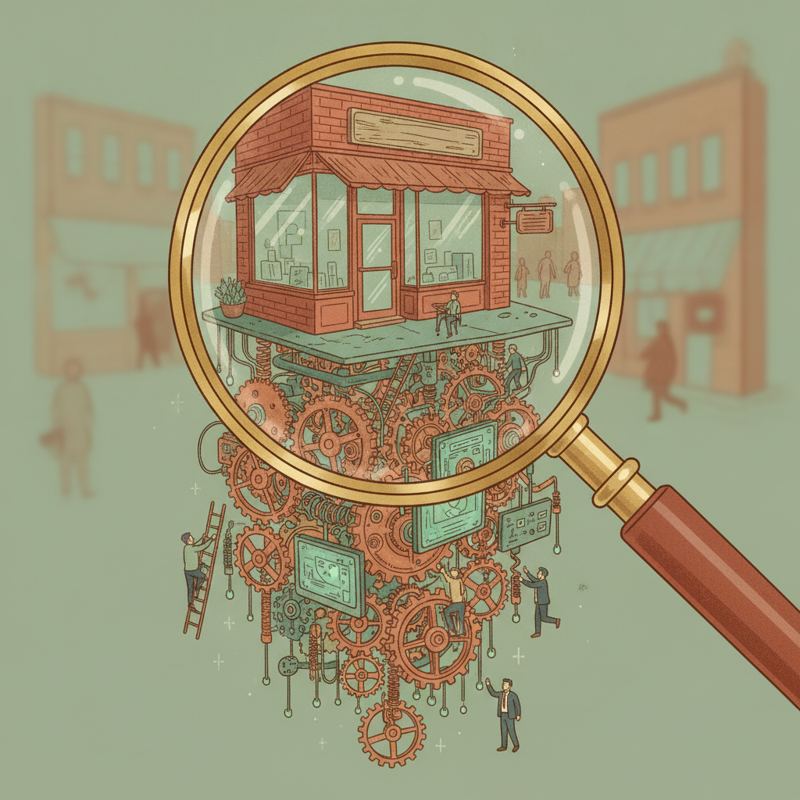
The same survey found AI adoption still tracks company size: 43% of businesses with 2-9 employees use AI, versus 59% of businesses with 100-249 employees. Bigger companies, with dedicated IT and ops people to evaluate and roll out tools properly, are still ahead. The stack didn't hand small teams a shortcut past this gap. It gave everyone a faster car and left the road the same length.
Where the Small-Team Edge Is Real
None of this means the small-team advantage is fiction. It means it shows up somewhere narrower than the pitch suggests. Look at what tasks people report using AI for and the picture sharpens: 90% for writing and editing, 88% for research, 86% for technical and coding work. These are the tasks once requiring either a specialist hire or a slow, expensive agency retainer. A five-person team gets a genuinely good first draft of a contract, a competitor analysis, or a piece of working code without hiring for any of it.
This is real. I've watched engineers on small teams ship features needing a specialist contractor two years ago, because the AI-assisted first pass gets them 80% of the way there. What I haven't watched is a five-person team run payroll, benefits, compliance, and customer support end to end on autopilot for $300 a month. This story sells newsletters. It doesn't match what workers report doing with these tools.
This Isn't a New Story. It's a Faster One
I led a mobile team of three at Crowdlab, a small analytics company, back in 2015. No AI tools existed to write our code or triage our tickets. We built two custom domain-specific languages and shipped a multi-language architecture into five new regions, serving over 100,000 users, with a team fitting around one table. We weren't fast because of the tooling available to us. We were fast because every person on the team knew exactly which corners to cut and which ones would break the product if we cut them.
This is the piece the "$300 stack" pitch misses entirely. Lean teams have out-punched their headcount for as long as software has existed. AI didn't invent this dynamic. It handed everyone a faster version of the same advantage, which is exactly why the advantage stops being about access to the tool and goes back to being about the judgment behind it. The JPMorgan and Chamber of Commerce numbers above are consistent with this: adoption speed jumped, but the size-based gap in who scales it well didn't close. This isn't a tooling story. It's the same leadership story it's always been, running on faster infrastructure.
What I'd Tell a Five-Person Team
If you're running a small engineering team and you read the "$300 stack" headlines and felt behind, stop. You're not behind on the tools. Everyone has access to the same models, the same coding assistants, the same drafting tools. Where teams separate from each other is judgment: knowing which draft is good enough to ship and which needs a second pass, knowing which workflow genuinely benefits from automation and which needs a human making the call every time.
I've mentored engineers moving into leadership roles, and the pattern holds there too. The tool never was the differentiator. The person deciding how to use the tool always was. Small teams win when someone on the team has enough judgment to tell the difference between "AI wrote a good first draft of this" and "AI made a decision needing a human." Bigger companies win the 43% vs 59% adoption gap because they have people whose job is figuring this distinction out at scale. Small teams win the task-level gap because a single sharp generalist adopts fast and iterates faster than a committee.

The Real Advantage Isn't the Stack
The advantage was never the $300. It's speed of judgment applied consistently, and this is a leadership problem before it's a tooling problem. I built a good chunk of my career on a version of this same idea, expressed at StepUp2Bat: teams move fast not because they have the fanciest tools, but because the person steering knows exactly which decisions to hand off and which to hold onto.
So the next time you see a headline promising you'll replace a department for the price of a nice dinner, ask a different question. Not "what does the tool do." Ask "who on my team knows when to trust it and when not to." This question doesn't have a subscription price. It's the actual gap between the teams pulling ahead and the ones still reading the newsletters.
What's the one task on your team where you'd trust an AI-assisted first draft completely, and what's the one where you never would?