Your Stress Isn't Yours Alone
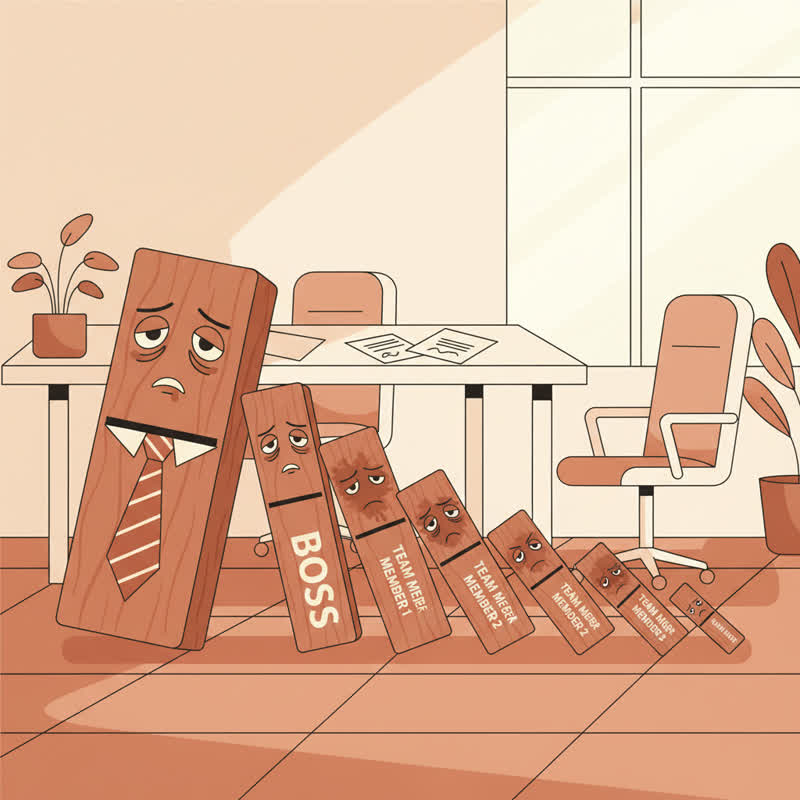
Here's a question nobody wants to hear: Is your burnout making your team sick?
I've spent years talking to leaders about bad bosses. My research found 99.5% of survey respondents said they've had one or more types of bad bosses. But one specific type gets overlooked... the leader who doesn't mean to be bad at all.
The Burnout Spreader.
You're not yelling. You're not micromanaging. You're working hard, staying late, answering Slack messages at midnight. Every single one of those behaviours sends a signal your team reads loud and clear.

The Science Says You're Contagious
This isn't pop psychology. A peer-reviewed study published in BMC Public Health tracked manager stress and employee well-being in a large Danish municipality over several years. The findings were blunt: approximately 10% of a manager's stress increase transfers directly to their employees within one year.
Ten percent doesn't sound like much. Until you consider how it compounds. Your stress infects your direct reports. Their stress infects their peers. And the effect persists for a full year before it starts to fade. The researchers called managers "nerve centres" for entire job teams... and they weren't being complimentary.
I've seen this play out dozens of times in my own career. A VP goes through a rough quarter. They start running hotter... shorter emails, tighter deadlines, less patience in meetings. Within weeks, their whole department shifts tone. People stop taking risks. Creativity dries up. Sick days increase. Nobody connects it back to the VP's stress, because the VP never talked about it. They didn't need to. Their body language did the talking for them.
The transmission happens two ways. First, through direct emotional contagion... your facial expressions, your tone, your body language. Research from Wharton found less than 10% of emotional communication happens through words. Your team reads your stress before you open your mouth.
Second, through behavioral changes. Stressed managers withdraw. They stop planning ahead. They provide less support. They make reactive decisions instead of thoughtful ones. Your team notices all of it.
The Numbers Are Brutal
Let's look at leadership burnout right now.
56% of leaders experienced burnout in 2024, up from 52% in 2023. Not a trend... an acceleration.
73% of C-level executives work without adequate rest. 43% of organizations lost at least half their leadership teams to turnover.
On the employee side: 52% of workers reported burnout in 2024. Mid-level managers... the people caught between senior leadership and the front line... hit the highest rate at 54%.
What connects these numbers: burned-out leaders create burned-out teams. It flows downhill. The people in the middle get crushed from both directions.
Five Signs You're Spreading Burnout
Most burnout spreaders don't know they're doing it. Check yourself against these:
1. You Wear Exhaustion Like a Badge
"I was up until 2am finishing the report." If your team hears this regularly, they're learning one lesson: the boss doesn't value rest. You think you're showing dedication. They hear a mandate.
2. Your Calendar Is a Weapon
Back-to-back meetings from 8am to 6pm. No breaks. No white space. Your team sees this and concludes: if the boss has no margin, I definitely don't have permission for margin.
3. You Respond to Messages at All Hours
You send a Slack message at 11pm. "No need to respond now!" you write. It doesn't matter. The notification landed. The anxiety landed with it. Your team now knows you're watching... even when you say you're not.
4. You've Stopped Asking How People Are
When you're drowning, small talk feels expensive. So you skip the check-ins. Go straight to the task list. Your team reads this as: my well-being doesn't matter here.
5. Your Default Answer Is "Push Through"
Someone tells you they're struggling. Your instinct is to motivate: "We've all got a lot on our plates right now." Translation received: your pain doesn't count.
Why the Best Leaders Are the Worst Spreaders
Here's the painful irony. The leaders most at risk of spreading burnout are the ones who care the most.
Adam Grant's research on givers, takers, and matchers shows givers end up at both the top AND the bottom of success rankings. They give until there's nothing left. And because givers rarely ask for help when overwhelmed, they burn in silence... while their stress leaks out in every interaction.
Dr. Tomas Chamorro-Premuzic, writing for McKinsey, noted a related problem: low-EQ bosses create enormous stress for their teams. But high-EQ leaders face a different trap. They absorb everyone else's stress on top of their own. They become emotional sponges. And when they hit their limit, the fallout hits harder because nobody saw it coming.
The leader who "has it together" is often the one closest to breaking. And when they break, their team breaks with them.
I've watched it happen. A CTO I know prided himself on never complaining. He absorbed every escalation, shielded his team from politics, and carried the weight of three roles after layoffs. His team loved him. They also noticed he'd stopped laughing. Stopped eating lunch. Started cancelling one-on-ones. Within six months, three of his best engineers quit. They told HR they were "burned out." Nobody pointed the finger at the CTO, who was also burned out. The stress had spread like a virus, invisible until the damage showed.
What to Do About It
I'm not going to tell you to meditate or take a bubble bath. Structural problems need structural solutions.
Model Recovery, Not Grind
Take visible time off. Close your laptop at a reasonable hour. Talk about your weekend. When your team sees you rest, they get permission to rest too.
Build a Stress Dashboard for Yourself
You track revenue, velocity, and uptime. Track your own stress signals with the same discipline. Sleep quality. Exercise. How often you snap at small things. Make it data, not feelings.
Ask the Uncomfortable Question
In your next one-on-one, try this: "Is there anything about my behaviour making your job harder?" Then shut up and listen. Don't defend. Don't explain. Write it down. Act on it.
Create Buffer Zones
Block two hours a week with no meetings. Protect lunch hours for your team. Set explicit "no Slack" windows. These aren't perks... they're infrastructure.
Get Your Own Support
If you're a senior leader, find a coach, a mentor, or a peer group outside your organization. You need somewhere to process your stress before it leaks onto your team.

The Real Test
Here's the question I want you to sit with: If I surveyed your team anonymously and asked "Does your manager's stress level affect your own?"... what would they say?
If the answer makes you uncomfortable, good. Discomfort is the first step toward change.
Your burnout is your responsibility. But its impact on your team is your leadership problem. The same contagion effect works in reverse, too. Leaders who model calm, boundaries, and recovery create teams who do the same.
Kelly Swingler, who first posed this "burnout spreader" question, puts it sharply: your stress is contagious, and if you're not managing it, you're normalizing it for everyone around you.
Stop spreading burnout. Start spreading something worth catching.