I've sat in both chairs.
As an employee, I've walked into December review season wondering if the promotion I earned in March was still on the table, or if the mistake I made in October had quietly buried it. As a manager, I've stared at a year's worth of notes and tried to write something honest and useful about work from six months ago.
It's a ritual satisfying nobody and changing almost nothing.
Adobe research found only 14% of employees feel performance reviews inspire them to improve. Fourteen percent. We spend enormous time and management energy on a process failing to motivate 86% of the people sitting through it.
There's a better way. It takes six minutes.

The Annual Review Is Broken by Design
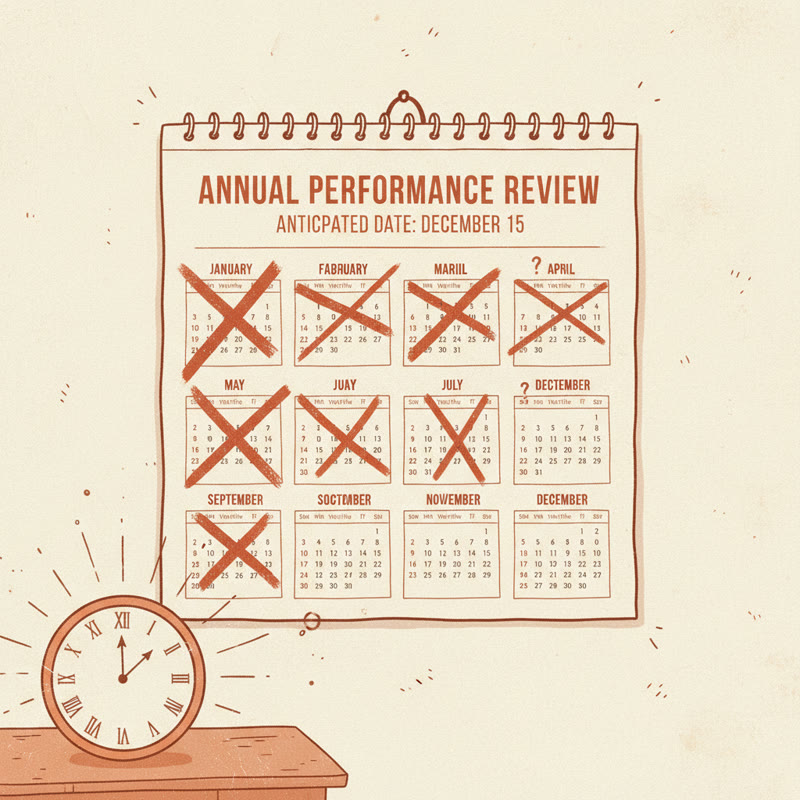
The core problem is timing. You do something brilliant in February. I don't tell you. I make a mental note. Six months later, I'm trying to reconstruct what happened and why it mattered, while you've forgotten the context and moved on.
Feedback arriving months after the fact isn't feedback. It's archaeology.
The system was built for a workplace where work moved slowly... where a year of output was genuinely hard to assess in real time. Those days are gone. Your engineers ship code every week. Your salespeople hit or miss quota every month. Your project managers hit walls and find workarounds constantly. The work itself is no longer slow enough to justify a once-a-year review cycle.
Waiting until December to tell someone what they did wrong in April isn't protecting them from criticism. It's denying them the chance to improve.
Recency Bias Is Writing Your Reviews
Even when managers try to do annual reviews well, their brains work against them.
Recency bias is the cognitive tendency to weigh recent events more heavily than older ones. In practice, whatever happened in October and November shapes the December review far more than anything from February through August. One bad sprint before review season tanks an otherwise strong year. One strong sprint before review season papers over months of mediocrity.
Neither outcome is fair. Neither is useful.
This isn't a character flaw in managers. It's how human memory works. If you want accurate assessments of performance over time, you need feedback loops happening over time. Not one snapshot at the end.
The annual review doesn't measure the year. It measures the last two months and pretends it measured twelve.
What Works Instead
Gallup research cited by Lattice found employees who received meaningful feedback in the past week were nearly four times more likely to feel engaged than those who didn't. Not somewhat more likely. Four times.
Betterworks' 2024 State of Performance Enablement report found employees who receive ongoing feedback are three times more likely to feel they perform their work well... and significantly more likely to see a path for internal career development.
The pattern is clear. Frequent, timely feedback doesn't replace performance management. It is performance management.
The annual review, when it exists at all, should be a formality. A summary of ongoing conversations, not a substitute for them. If your employee is surprised by anything in their annual review, you've already failed them. The review should contain nothing new.
The Six-Minute Rule
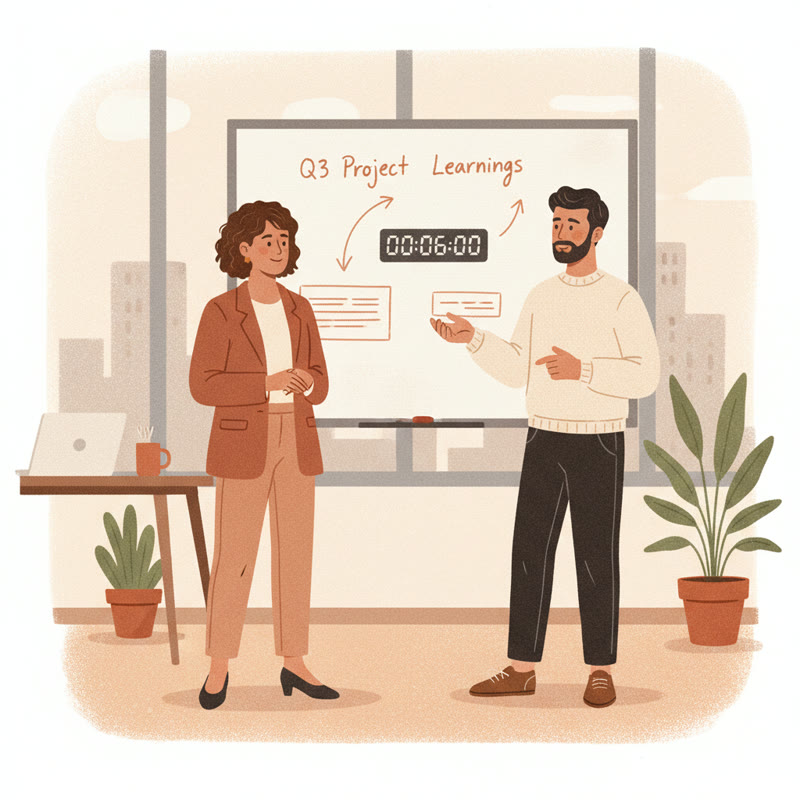
Here's the practical version. After any notable event... a good piece of work, a missed deadline, a tricky client conversation, a solid bit of problem-solving... take six minutes.
Not six hours. Not a scheduled meeting. Six minutes, as close to the event as possible.
Two minutes to say what you observed. Be specific. Not "good presentation" but "the way you handled the technical objections in the Q3 demo was sharp... you didn't get defensive, you asked questions first."
Two minutes to say what impact it had. On the team. On the project. On the client. On you.
Two minutes to say what you'd like to see more of, or what to do differently next time.
No forms. No scoring. No HR portal.
This is the core of the SBI framework: Situation-Behavior-Impact, which has been around for decades. The idea isn't complex. The failure is in not doing it.
"But We Need Documentation"
I know the objection. HR needs records. Promotions need evidence. Legal needs paper trails.
Fine. Write it down in a shared doc after you have the conversation. Three minutes. Send the employee a note: "After the client call today... you handled the pushback well. Logging it." Done.
What you're building is a living record of actual performance throughout the year. When review season comes, you're not guessing. You have evidence. Your employee has context. The conversation becomes confirmation, not revelation.
66% of employees say they'd consider leaving a job where they felt unappreciated... and among millennials, 76%. Regular, specific feedback is one of the most direct ways to show someone their work is seen. It costs nothing but attention.
The Real Cost in Tech
In software teams, the stakes are higher than most people admit.
A developer who gets unclear feedback in December about a pattern they started in March has been writing bad code, building bad habits, or solving the wrong problems for nine months. The annual review didn't save anything. It baked the problem in.
Real-time feedback in technical teams isn't soft-skills theater. It's engineering quality control. The same discipline you'd apply to a code review... catching problems at the point of origin, not six months downstream when they're load-bearing... applies to everything else people do.
Feedback is a form of testing. Annual reviews are testing in production.
Start Monday
Pick one person on your team. Think of the last time they did something worth noting... good or bad. Have a six-minute conversation about it this week.
Don't announce a new feedback system. Don't run it by HR. Don't wait for the right moment or the right format.
Do it once. See what happens.
My strong suspicion is you'll find two things: it takes almost no time, and it changes the relationship more than you'd expect. People don't need to be managed into compliance. They need to know where they stand. Real-time feedback gives them the clarity they need... and frees you from the December scramble of trying to do a year's worth of managing in one awkward hour.
Six months from now, your annual review conversation will be the easiest one you've had. Because it won't contain any surprises.