Your team is slow. You know it. Stand-ups drag, pull requests sit for days, and every estimate doubles before the work ships. So you do what most leaders do. You buy a faster CI pipeline. You add a new project board. You bring in a process consultant who promises velocity.
None of it works. Here is the brutal truth most engineering leaders refuse to hear: your speed problem is a trust problem. And no tool will fix it.

The hidden tax you pay every single day
When trust is low, your team pays a tax on every action. Nobody calls it a tax. It hides inside other words.
It hides in the three approvals needed before a one-line change goes live. It hides in the engineer who spends an hour writing a defensive Slack message to cover herself before she touches a shared service. It hides in the senior dev who reviews every junior commit line by line, not to teach, but to catch them out.
Each of those moments feels responsible. Careful. Grown-up. Add them together across forty people across a year, and you have lost months of real work to fear.
I have seen this in teams I have led and teams I have rescued. The org chart looked fine. The tooling was modern. The people were smart. The work still crawled. Once you start looking for the trust tax, you see it everywhere.
The research is not subtle
People treat trust as a soft topic, a thing for the HR away-day. The data says otherwise.
A peer-reviewed study published in Frontiers in Psychology measured organisational trust against business outcomes across a national sample of working adults. The findings are hard to wave away. Workers in the highest-trust group were more than 250% more productive than those in the lowest-trust group. They reported 42% higher job satisfaction. They took 8.5 fewer sick days. They stayed 28 months longer, and 95% of them planned to keep staying.
Read those numbers again. Not 5% faster. More than two and a half times more productive. There is no refactor, no framework migration, no AI coding assistant on the market today with a return like a high-trust culture.
The reason is mechanical, not mystical. Paul Zak, who ran the underlying neuroscience, lays out the chain in The Neuroscience of Trust in Harvard Business Review. When people feel trusted, their brains release oxytocin, stress drops, and they direct energy at the work instead of at protecting themselves. Low trust does the opposite. It floods people with cortisol and turns them inward. A scared engineer writes scared code.
Software teams prove it harder than anyone
If you think this is generic workplace fluff, look at the research closest to home.
Google ran a two-year study of its own teams called Project Aristotle. They measured 180-plus teams looking for the magic mix of skills and personalities. The biggest single differentiator between high and low performing teams was not talent, tenure, or IQ. It was psychological safety: a shared belief among teammates the team is safe for taking risks, admitting mistakes, and asking dumb questions out loud.
Psychological safety is trust wearing a lab coat.
The DevOps research from DORA backs this up at the delivery level. After years of studying what makes software organisations ship faster and safer, they found a high-trust, generative culture predicts both software delivery performance and organisational performance. They lean on Ron Westrum's work, which sorts cultures into three types by how they treat information. In a pathological culture, messengers get punished. In a bureaucratic one, messengers get ignored. In a generative one, messengers get trained, and failure leads to inquiry instead of a hunt for someone to blame.
Ask yourself honestly which of those three describes the last time something broke in production on your watch.
What low trust looks like in code
Trust is abstract until you see its fingerprints in the actual work. Here is where I find them.
Deploys become rituals. A high-trust team ships small changes many times a day. A low-trust team batches everything into a terrifying monthly release with a war room and a rollback plan, because nobody believes the people or the tests.
Reviews become interrogations. Healthy code review teaches and catches real bugs. Fearful code review is a status game where the reviewer proves dominance and the author defends their worth. Same activity, opposite outcome.
Estimates inflate. When people fear being punished for being wrong, they pad every number. Your roadmap turns into fiction nobody believes, including the people who wrote it.
Knowledge hoards. In a low-trust shop, information is power, so people sit on it. The one engineer who understands the billing system likes being indispensable. Bus factor of one is a trust symptom, not an accident.
Most leaders make it worse
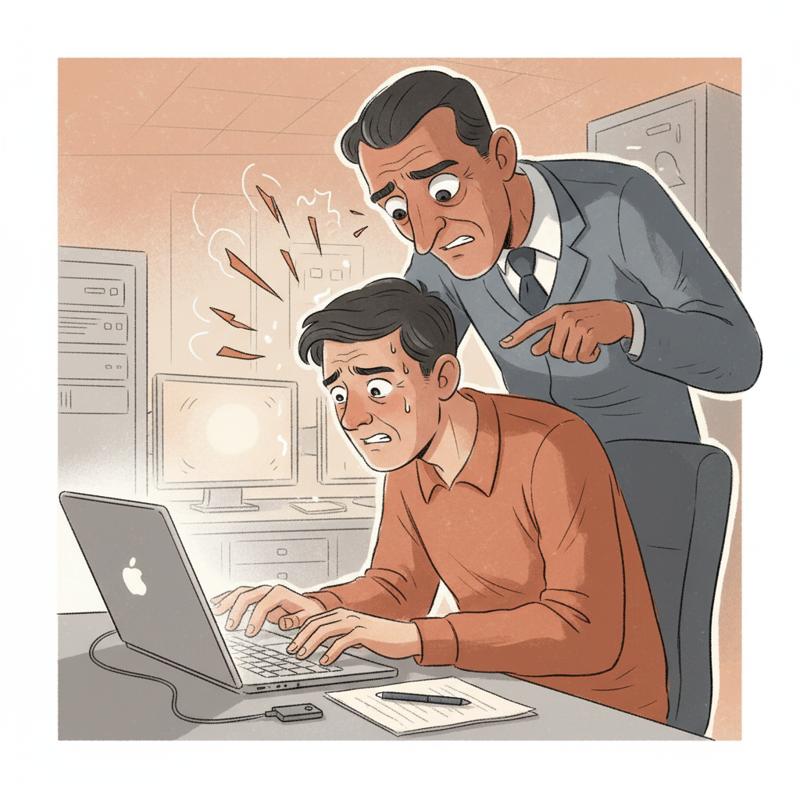
When a team slows down, the instinct of an anxious leader is to tighten the grip. More reporting. More check-ins. More sign-offs. More dashboards to watch people through.
Every one of those moves says the same thing to your team: I do not trust you. And your team hears it perfectly. They respond by doing the minimum, covering their backs, and going quiet in the meetings where you need their honesty most.
My own research into bad management found 99.5% of people have suffered under one or more types of bad boss. Read the descriptions of those bosses and almost all of them reduce to a failure of trust. The micromanager does not trust your judgement. The credit-stealer does not trust you to be loyal if you get the recognition. The absent boss does not trust themselves to handle a hard conversation. I write about this pattern a lot over at Step It Up HR, because the fix is a leadership skill, not a perk.
How to build it back, starting Monday
Trust sounds vague, so leaders treat it as a mood they hope arrives. It is not a mood. It is the residue of specific behaviours repeated over time. The way to change a culture is to change what people do, not what they say they believe.
Here is where I start.
Extend trust first. Trust is a loop, and someone has to go first. As the leader with the most power in the room, it is you. Give a junior the scary task. Let someone own a decision you would normally make. Then back them in public when it wobbles.
Make failure safe out loud. Run blameless post-mortems and mean it. The first time something breaks and you ask "what did the system let happen?" instead of "who did this?", you teach your whole team it is safe to tell you the truth. The next outage gets reported in minutes instead of hidden for hours.
Shrink the batch size. Small, frequent deploys are not only an engineering practice. They are a trust practice. They prove to the team you trust them to ship without a chaperone, and each safe release builds the confidence for the next.
Cut the approvals you cannot defend. Walk through your sign-off chain and ask of each step: what real risk does this catch? Most exist because of one bad incident years ago and now tax every change forever. Remove them and watch how fast people move.
Say thank you, specifically. Recognition is the cheapest trust-builder you own and the most neglected. Not generic praise. Name the exact thing the person did and why it mattered.

The payoff
You will not see the gain on a burndown chart next week. Trust compounds slowly, then all at once. The approvals fall away. The honest conversations start happening before the disaster instead of after it. People stop protecting themselves and start protecting the work.
One day you notice the team is shipping fast, and you cannot point at the tool which did it. There was no tool. You stopped taxing them, and they gave you back the months you were burning.
So before you buy the next platform which promises velocity, look at your own behaviour. Are you the leader people tell the truth to, or the one they manage around? Your team already knows the answer. The only question is whether you are brave enough to ask them.
What would your team ship if they stopped spending half their energy protecting themselves from you?