Every engineering org I have worked in has one.
The person who takes the call at 3am. The one who knows why the batch job dies on the last Friday of the month. The one whose name comes up at the all-hands, because something big broke and got fixed before customers noticed.
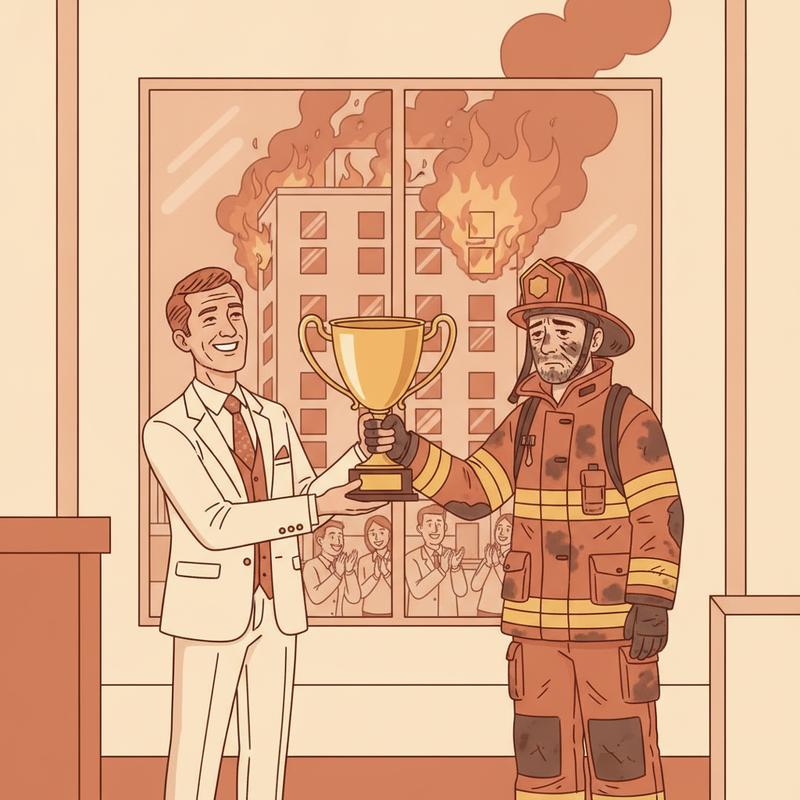
We give them a bonus. We put them on a slide. We tell new starters to be more like them.
Then we wonder why nobody volunteers for the on-call rota.

The applause is the problem
Every time you reward the 3am fix, you buy another one.
You have told your team where the money is. Not in the dull work of making the batch job survive a retry. Not in the runbook nobody reads. The money is in the save. The money is in the pager going off and someone riding in.
People read incentives well. Yours are loud and clear.
Google's SRE practice says it without flinching: "Heroism masks systemic problems, the systemic problems are never fixed." Their note on heroism lists three casualties. The system stays broken, because the pain never reaches anyone holding a budget. The team learns unrealistic expectations about how much work a normal week holds. And the hero picks up, in their words, "vast quantities of uninteresting, low-impact work" with no career progress to show for it.
Read the last one twice. Your hero does rote labor, at night, for a pat on the head.
A hero is a bug report about your org
I treat heroics as telemetry now.
When someone saves the day, I do not ask how they did it. I ask why anyone needed to save it. What went unfunded eighteen months ago. Which alert has fired every week since March with nobody free to kill it. Which single person holds knowledge nobody else has, because writing it down never made the sprint.
The heroics are not the story. They are the symptom your monitoring failed to catch.
Google's SRE book puts a hard number on the limit. Keep "operational work (i.e., toil) below 50% of each SRE's time." The other half goes to engineering the toil away. Cross the line and you get what they describe plainly: "Too much toil leads to burnout, boredom, and discontent." Worse for the business, it will "motivate the team's best engineers to start looking elsewhere for a more rewarding job." Their chapter on eliminating toil says it best.
You are not retaining your best engineer by praising them. You are giving them a reason to update their CV.
Your hero is a single point of failure
Here is the part finance understands.
Draw your architecture diagram. Now draw a second one with the people on it. On the second diagram, your hero is a box with every arrow pointing into it and no redundancy behind it. In any other part of the system you would call it an outage waiting for a trigger. On the people diagram we call it a star performer and give them a plaque.
I watched a team lose a payments platform for most of a working day because the one person who understood the reconciliation logic was on a plane. Nobody had done anything wrong. Nobody had been lazy. The org had spent two years rewarding one person for knowing something alone, and never once paying anyone to write it down.
The recovery plan afterwards was a rota change. It should have been a knowledge audit.
Ask a simple question about every service you run. If the person who understands it took a month off, what breaks and how long does it stay broken? Write the answer down. If reading it back makes you uncomfortable, you have found the work for next quarter.
The bill arrives eventually
Long hours are not a personality trait. They are a health exposure with numbers attached.
The WHO and ILO joint study counted 745,000 deaths in 2016 from stroke and heart disease linked to long working hours. A 55 hour week or longer carried a 35% higher risk of stroke and a 17% higher risk of dying from ischemic heart disease. Deaths from the same cause rose 29% between 2000 and 2016.
Your on-call rota makes a small contribution to a large pile of bodies. I take no pleasure in writing it in those terms. The research says what it says.
Instability is the root cause, not weak people
The temptation is to treat burnout as a personal resilience gap. Send them on a mindfulness course. Buy fruit for the kitchen.
The 2024 DORA report kills off the idea. Its finding on wellbeing is blunt: "Unstable organizational priorities cause meaningful decreases in productivity and substantial increases in burnout." Then comes the part leaders hate. The damage "is highly resistant to mitigation and persists even in environments with strong leaders and high-quality documentation."
You do not fix a thrashing roadmap with a wellbeing app. The thrash is the injury.
DORA found the lever with real leverage too. Leaders who "inspire, intellectually stimulate, and support their teams" cut burnout while lifting satisfaction and organizational performance. Same report, same survey of nearly 3,000 tech workers.
So the causes sit with leadership. The fixes sit with leadership. Neither one sits with the person holding the pager.
What rewarding rest looks like in practice
Praise for rest with no structural change is theater. Your team spots it inside a week. Try these instead.
Put toil on the roadmap with a name and a number. Track hours lost to interrupt work per team, per sprint. Report it next to feature delivery. Anything you refuse to measure, you have decided to tolerate.
Make the post-incident question structural. Ban "who fixed it" from the review. Ask what made the fix necessary, then fund the answer in the next sprint, not in the mythical quiet quarter.
Pay for boundaries, not for saves. Someone works a night, they take the day. Enforced, visible, no negotiation. A manager who lets a tired engineer soldier on runs a false economy with someone else's health.
Stop changing your mind in public every fortnight. Priority stability is a wellbeing intervention. DORA's data says so. Your team worked it out years ago.
Reward the invisible work. The engineer who deleted the alert nobody needed saved more sleep than the one who answered it at 3am. Say so at the all-hands. Put their name on the slide.

The uncomfortable bit
Hero culture flatters managers. A save feels like leadership. Sitting through a boring quarter of hardening work while your peers ship features feels like nothing at all.
My own research found 99.5% of survey respondents had experienced one or more types of bad boss. Not a rounding error. Near enough everyone. And most of those bosses were doing what the system rewarded them for doing. Fix the reward, and you fix a lot of the bosses.
Meanwhile, Step It Up HR puts employee engagement at only 21%. The heroics look like commitment. The engagement numbers disagree.
If your team ships steadily, sleeps through the night, and goes home at a sensible hour, you have built something good. It will not feel dramatic. Boring is the goal. Boring is what a well-engineered system looks like from the outside.

One question to take away
Look at your last four incidents. Look at who got named in the retro, who got the thanks, and who got a bonus.
Now look at whoever spent last quarter doing the unglamorous work of keeping the pager quiet. Did anyone say their name out loud?
If not, you already know where your next 3am call is coming from.