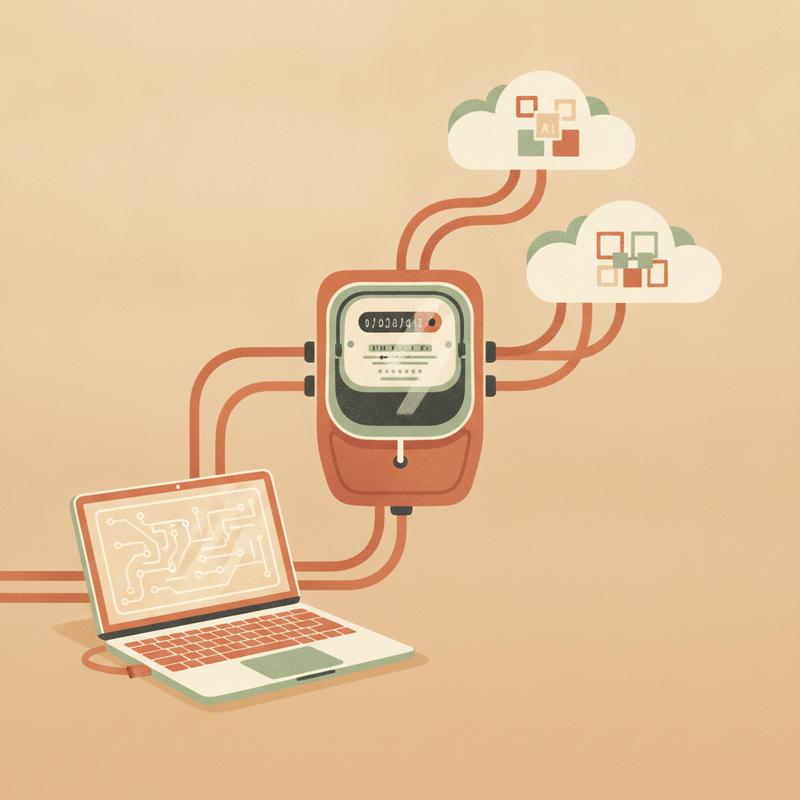
On June 1, 2026, GitHub Copilot stopped being a gym membership and became a taxi meter.
For three years, "unlimited" Copilot access cost whatever your plan cost. $10 a month, $39 a month, use it as much as you liked. Then GitHub flipped a switch and started billing by the token. Input tokens, output tokens, cached tokens, all metered against a monthly credit allotment. Go over, and you pay for every extra credit you burn.
I've watched a lot of software pricing changes over the years. Most of them are boring. This one isn't, because it tells you something bigger than "Copilot got more expensive." It tells you what's happening, right now, to every AI tool you've built your business on.

What Changed, Exactly
GitHub's own announcement is refreshingly honest about why they did it. Their line: "a quick chat question and a multi-hour autonomous coding session cost the same amount" under the old system. Flat-rate pricing worked when Copilot was mostly autocomplete, a suggestion here, a finished line there. It stopped working the moment developers started running agentic sessions, the kind where you hand off a task and Copilot edits dozens of files unattended for an hour.
Under the new model, each plan gets a monthly credit allotment tied to its price. Pro at $10 gets $10 in credits. Pro+ at $39 gets $39. One credit is one cent. Burn through your allotment and you're either buying more, or you're throttled until next month's cycle resets.
Here's the number worth sitting with: developers running heavy agentic workflows reported bills jumping from $29 to $750 a month. Others watched $50 turn into $3,000. Not because they did anything wrong. Because the meter finally started counting what they were already using.
The Backlash Was Loud, and It Aimed at the Wrong Target
The reaction on Reddit, X, and GitHub's own discussion boards was, by every account I read, immediate and furious. One developer's post read simply: "Goodbye, Copilot." A Reddit comment cut sharper: "The only one at fault here is Microsoft. They trained us to vibe code, and now they're charging us for it." TechCrunch went so far as to call it the end of Copilot's "golden age."
I understand the anger. Nobody enjoys a bill ten times higher than expected with no warning. But the framing, "Microsoft screwed us", misses what's truly going on underneath it. Copilot didn't get greedy. It got honest. The old flat rate was never sustainable once agentic coding became the default way people used the tool, it was subsidized while GitHub worked out its real cost structure. Every AI product built on frontier model inference sits on the same clock. Copilot hit it first, and hit it in public.
This Isn't a Copilot Story. It's an Infrastructure Story.
Here's what I think founders and engineering leaders are missing while they argue about GitHub specifically: AI tools are quietly reclassifying themselves from software into utilities, and most budgets haven't caught up yet.
SaaS pricing has always rested on one assumption: marginal cost near zero. Build the software once, sell it a thousand times, and the cost per customer barely moves. Twenty years of "unlimited" plans got funded on this assumption. AI-native tools break it completely. Every request burns real inference money, on real GPUs, at a real cost per token. There is no version of an "unlimited AI coding assistant" free of this math forever. Somebody was always going to pay the difference, and it was never going to stay GitHub.

Electricity, water, cloud compute, we already know how to plan around usage-scaled costs. Nobody complains when their power bill rises because they ran the air conditioning harder in August. We simply haven't filed "AI coding assistant" into this mental category yet, and Copilot's rollout forced the reclassification badly, loudly, and in public. The direction is still correct, even where the execution stung.
GitHub isn't alone here either. Competitors including Anthropic, Google, and Cursor are moving through versions of the same shift, tying price closer to compute consumed rather than seats sold. If your product or your team leans on any AI vendor, this is the pattern to watch, not the exception.
What This Means If You're Running a Team
I'm not writing this to pile on GitHub. I'm writing it because if you lead an engineering team, or you're a founder whose product runs on top of AI models, this ought to change how you plan for the rest of the year.
Budget for AI tools like infrastructure, not software. Give them a variable line item flexing with usage, not a fixed row in the same spreadsheet as your project management subscription. Put someone specific in charge of watching it monthly. Teams treating AI tooling spend as a flat SaaS cost are going to get surprised again before the year is out. This won't be the last usage-based pivot in this space.
Build model-agnostic wherever it reasonably fits. If your product or your team's whole workflow depends on one vendor's pricing staying flat forever, you've taken on a risk without choosing it. Abstraction layers letting you swap models, or route lower-stakes work to a cheaper option, aren't premature engineering anymore. They're basic risk management, the same way a founder wouldn't build a whole business on a single supplier without a backup plan.
Know what your agentic workflows cost before you scale them. The developers hit hardest were running autonomous, multi-file agent sessions, exactly the workflows most engineering teams are racing to adopt right now. Before rolling agentic coding out across a whole team, price out what one heavy session costs in tokens. Learn it from a test run, not from the invoice.
Building StepUp2Bat On Borrowed Time, Knowingly
I build StepUp2Bat on AI tooling every day, and this shift is one of the reasons I've pushed hard toward model-agnostic architecture from early on rather than betting the whole product on one vendor's roadmap and one vendor's pricing page. It's more work up front. Swapping models is a config change instead of a rewrite, and pricing shocks like this one become a Tuesday-afternoon adjustment rather than an existential threat to the roadmap. I'd rather pay this price early than get the invoice later.
None of this means avoiding AI tooling, or treating every vendor with suspicion. It means building the way you'd build around any critical supplier: with a fallback, with visibility into cost, and without assuming the terms you signed up under will hold forever. Founders who skip this step aren't being reckless on purpose. They're usually moving fast and trusting the pricing page to stay put. Copilot's June rollout is proof it won't.
The Real Question
The developers furious about their Copilot bill aren't wrong to feel blindsided. Nobody signs up expecting a bill 10x higher with zero warning. But the anger is pointed at the wrong place. Flat-rate AI tooling was always going to end. The only open question was when the meter would start running, and who would be first to turn it on in public.
If your business runs on AI tools, ask yourself honestly: do you know what your usage costs today, in real numbers, or are you still assuming it's a fixed line item because nobody's made you look yet?