Every AI demo works
I have sat in rooms where a prototype gets something close to applause. Someone shares a screen. A model reads a messy document, pulls out the right numbers, writes a tidy summary. An executive leans forward and asks why this is not live yet.
Six months later, it is still not live.
The model did not get worse. The demo was never the hard part. A demo is the easy ten percent, and everyone in the room treats it as proof of the other ninety.
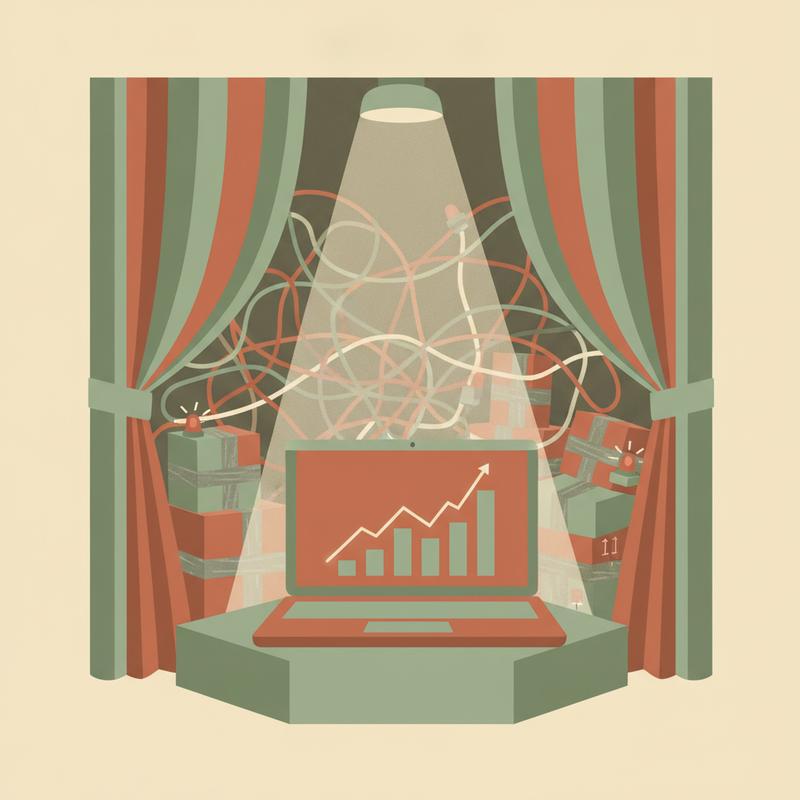
The numbers nobody puts on the slide
MIT's NANDA initiative published a report called The GenAI Divide: State of AI in Business 2025. They interviewed 150 leaders, surveyed 350 employees, and reviewed 300 public deployments. Their finding, covered by Fortune, was blunt: 95 percent of generative AI pilots produced no measurable return.
Read the reason carefully, because most people skip it. The failures were not about model quality. They came from what the report called flawed enterprise integration. The models were fine. The wiring around them was not there.
Gartner predicts more than 40 percent of agentic AI projects will be scrapped by the end of 2027. The reasons they list are rising costs, unclear business value, and weak risk controls. Anushree Verma, a senior director analyst there, called most agentic AI projects "early-stage experiments or proof of concepts ... mostly driven by hype and ... often misapplied."
She added a line worth pinning to your wall. Many use cases positioned as agentic today do not need an agentic implementation at all.
And one more figure from the same work, reported by RCR Wireless: out of thousands of vendors selling agentic products, Gartner counts around 130 with genuine agentic features. The rest is marketing paint.
Why the demo lies to you
A demo lies in four specific ways, and none of them are dishonest. They are structural.
It runs the happy path. You picked the input. You knew the answer. Nobody fed it the 2019 scanned PDF with the coffee ring on it.
It has one user. Concurrency, rate limits, retries, queue depth, cold starts. None of these exist at a table with three people watching.
Nothing happens when it is wrong. In a demo, a wrong answer is a laugh and a "let me try another one." In production, a wrong answer touches a customer, a payroll record, or a regulator.
A human quietly fixed things. Somebody reran the prompt. Somebody cleaned the file first. In production, nobody is standing there to nudge it.
Strip those four crutches away and you are looking at a different system. Building the second system is the work. The prototype was the pitch deck.
The four boring things standing between you and production
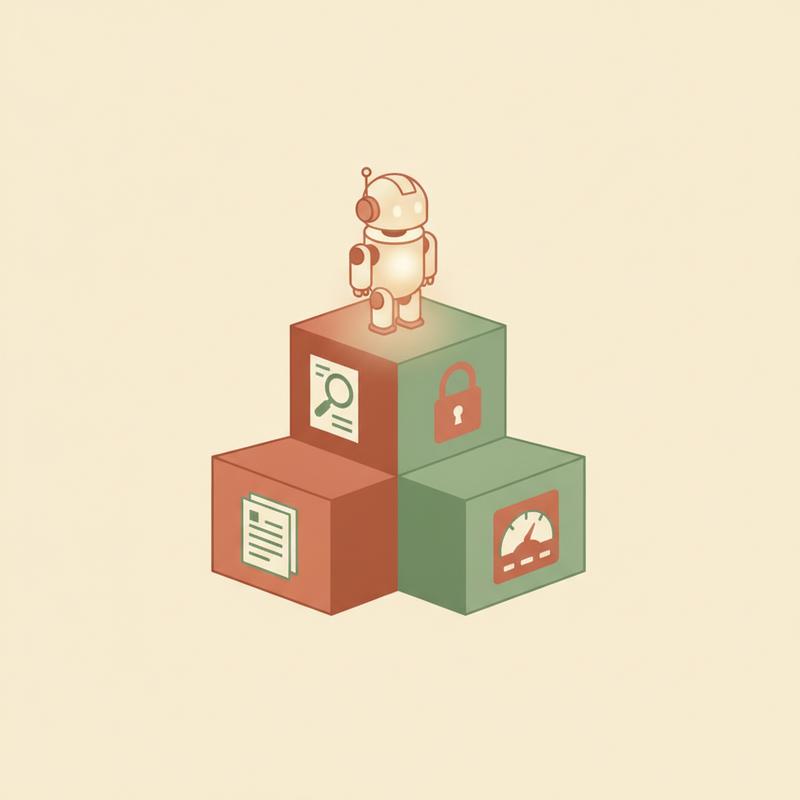
Every AI project I have watched stall got stuck on the same short list. None of it is glamorous. All of it decides whether you ship.
1. Evaluation you trust
You need a way to answer "is it better than last week?" without a person eyeballing ten outputs and shrugging. Write a test set from real inputs, including the ugly ones. Score it. Run it on every change to the prompt, the model, or the retrieval layer.
Teams skip this because tests are dull and vibes are fast. Then a vendor ships a new model version, quality shifts underneath them, and nobody notices for three weeks.
2. An audit trail
For every output, you need the input, the model version, the prompt version, the retrieved context, the timestamp, and the person or system asking. Log it before you launch, not after your first incident.
I would go further. If your AI touches anything about a person, the audit trail is the product. Being able to explain a decision six months later matters more than shaving 200 milliseconds off the response.
3. Access control
Retrieval systems are extremely good at finding documents people were never supposed to read. Your model has no concept of a permission boundary unless you build one. Every retrieval query needs the requesting user's permissions applied at the query, not filtered afterwards.
This is the failure mode with the shortest path from clever demo to legal call.
4. A cost and latency budget
Set a target for cost per completed task and response time before you build. Not per token. Per task a human cares about. Then watch what happens when you add retries, longer context, and a second model checking the first.
Plenty of pilots die here. The economics work at ten requests a day and fall apart at ten thousand.
AI amplifies whatever you already are
The 2025 DORA report surveyed nearly 5,000 technology professionals. Ninety percent use AI at work. More than 80 percent believe it made them more productive. Thirty percent report little or no trust in the code it writes.
Sit with those last two numbers together for a moment.
The report found a positive relationship between AI adoption and delivery throughput. It also found a continuing negative relationship with delivery stability. More output, less steadiness. Their explanation is the sharpest thing I read all year:
"AI doesn't fix a team ... it amplifies what's already there. Strong teams use AI to become even better and more efficient."
Struggling teams get the opposite. The report says AI highlights and intensifies the problems they already had.
If your team has weak tests, unclear ownership, and slow feedback loops, AI hands you a faster way to produce work nobody is checking. The prototype felt like magic because it had no consequences attached. Production attaches all of them at once.
What I would do on Monday
Pick one workflow with a countable outcome. Not "AI for customer service." Something like "reduce time to first response on refund requests." If you cannot count it, you cannot defend the budget in month four.
Write the kill criteria first. Decide now what result at week twelve means you stop. Teams without kill criteria do not stop. They shuffle the project sideways and rename it, and the money keeps leaking.
Build the audit trail before the feature. It takes two days at the start and two months once you are live.
Be honest about build versus buy. The MIT work found purchases from specialized vendors succeeded around two thirds of the time, while internal builds succeeded roughly a third as often. Your engineers will want to build it. Sometimes they are right. Make them argue for it against those odds rather than assuming.
Give people time to learn the tool. Mandating usage and then measuring tool adoption produces theatre, not capability. Measure the outcome and let the team work out the route.
The gap is organizational, not technical
Here is the part leaders avoid. Nothing on my list is a machine learning problem. Evaluation, logging, permissions, cost discipline, honest measurement, knowing when to stop. Every one of those is a question about how your organization makes decisions and whether people feel safe reporting bad news.
Teams stuck between demo and production usually have someone who already knows why. A staff engineer said it in week two. It did not travel upward, because the project had a launch date and a sponsor with reputation attached. The information existed. The path for it did not.
Fixing it is leadership work, not a tooling purchase. It is the same muscle I write about over at Step It Up HR, and it is the difference between a team improved by AI and a team exposed by it.
So the question is not whether your prototype works. Prototypes work. The question is what your organization does with the first person brave enough to say the production version does not.