I once asked one question in a standup and got two answers.
Was the migration on track? London said yes. Chennai said yes. Six weeks later it was nowhere near on track, and both halves of the team had known it for a month.
Nobody lied to me. Two groups of people held two different ideas of what "on track" meant, who they were answering to, and what happens to a person who says the awkward thing in front of everyone.
Your org chart draws one box around those people. Inside their heads there are four.
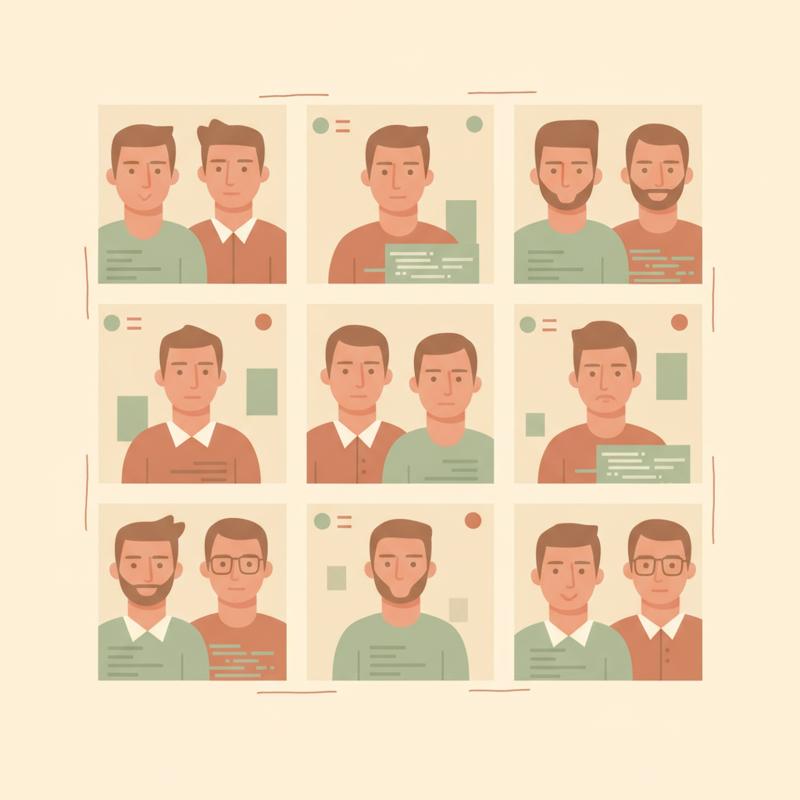
Everyone carries a stack of identities, and one of them is louder than the rest
Sit in any distributed engineering team and count the memberships in the room.
National. Company. Site. Function. Squad. Tenure. Employment status. Time zone. Whether your laptop was issued by the client or by the agency.
Each person holds all of these at once. At any given moment, one sits on top of the stack and does the talking. Which one wins depends on what is happening around them. Ask about the roadmap and the squad identity answers. Put a delivery date under threat and the site identity answers. Announce a reorg and the employment-status identity answers, loudly.
I call this an identity cascade. The stack reshuffles, the loudest layer changes, and the same person gives you a different answer on Thursday than they gave you on Tuesday. Then you go home wondering why your global team behaves so strangely.
They are not being strange. You are talking to a different layer of the stack.
The group does not have to be real to do damage
Henri Tajfel ran a set of experiments in the 1970s now known as the minimal group paradigm. He split strangers into groups on nothing at all. A coin toss. A preference between two painters they had never heard of.
People still favoured their own side. They gave up personal reward to make their arbitrary group come out ahead of the other arbitrary group.
Read the tooling in your own org through the same lens.
Two Slack workspaces. Two on-call rotas. Two names in the deploy pipeline, one of them called "core" and the other called "support". Badge colours. A repo one group owns and the other group raises tickets against. Standups at 9am in the head office time zone, which is 6:30pm somewhere else.
None of these looks political. Every one of them is a coin toss with a budget behind it.
Perceived splits do the harm, not demographics
Here is the finding I keep coming back to, because it points the finger away from the people and back at the leader.
Tiede, Schultheis and Meyer studied 48 teams and 105 people in a 2021 paper in Frontiers in Psychology. They looked at demographic faultlines, meaning the objective splits you get from age, gender, nationality and the rest. Then they looked at perceived subgroups, meaning whether people felt the team had split into camps.
The demographic faultlines did not predict emotional exhaustion. The perceived subgroups did. Stronger perceived subgroups produced weaker identification with the team, and weaker identification with the team produced more exhaustion. Their conclusion was to work on the perception of subgroups rather than on the demographic mix.
Read the implication slowly. A team of six nationalities across four time zones is not doomed. A team of six nationalities across four time zones where everyone knows which half gets the interesting work is doomed.
You do not fix this by hiring differently. You fix it by removing the signals telling people which camp they are in.
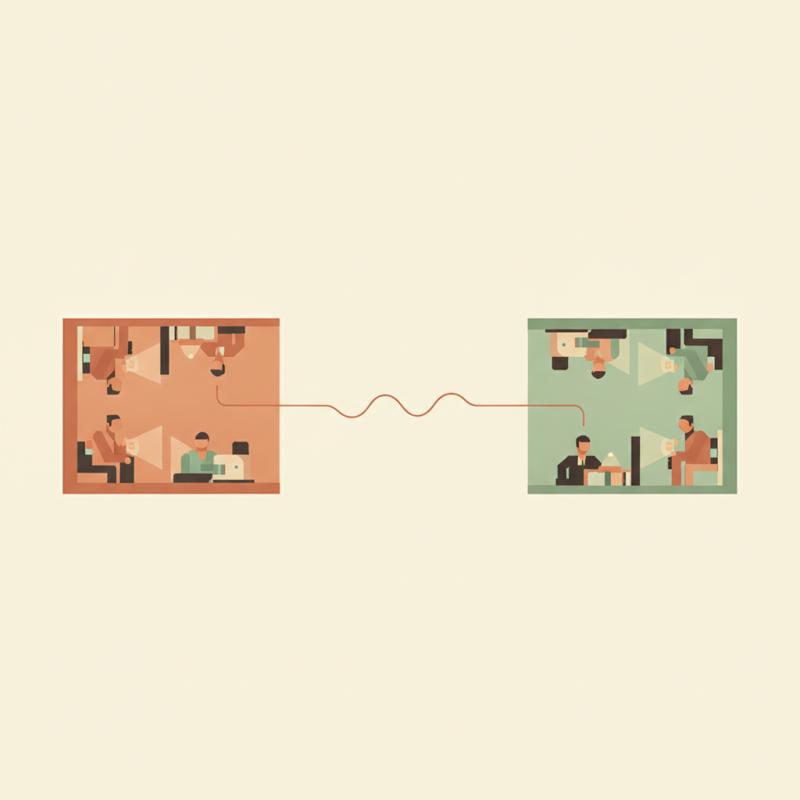
Remote work turned the volume up
Microsoft researchers studied more than 61,000 of their own employees through the shift to company-wide remote work, and published the results in Nature Human Behaviour in 2021. Time spent working with people outside your immediate group fell by around 25 percent. Communication moved towards email and chat. The network got more siloed, and people wound their inner circle tighter. Coverage of the study is available from BIG Media.
I am not arguing for return to office. I am pointing out what the numbers describe. Left alone, distributed work strengthens the layer of the stack nearest to you and weakens every layer above it.
Your squad becomes the real team. The wider group becomes a slide in someone else's deck.
Direct feedback lands differently depending on where it lands
I am American. I was in the US Army before I ever managed an engineer. Both of those things trained me to say the problem out loud, in the room, in plain words, and to expect gratitude for it.
Then I spent years working with teams in Britain, and later with people spread across several countries, and learned my plain words were arriving as something else entirely.
Edward Hall described this split back in 1959 as high-context and low-context communication. Low-context cultures put the meaning in the words. High-context cultures put a good part of the meaning around the words, in what is implied, in what is left unsaid, in who is present.
The same page reports a 2022 study by Burmann and Semrau across 54 banking teams in Germany and Brazil. In Germany, with its direct communication style, social divisions in a team turned into task conflict and hurt performance. In Brazil the same divisions did not produce the same result.
I'm not sure about this part: I read a summary of the Burmann and Semrau study rather than the full paper, so treat the mechanism as suggestive rather than settled.
The practical version is simpler. Your design review feedback is not neutral. It is written in your dialect. Somebody two time zones away is decoding it with a different key, and the decode either pulls them into your team or pushes them into their own.
What to do on Monday
None of this needs a culture programme. It needs a leader willing to change what is salient.
Name the split out loud. Say the words. "There are two camps in this team and I helped build the fence." People already know. Silence from you confirms the fence is policy.
Audit your status markers. Who is on the incident channel. Who joins the customer call. Who gets the greenfield service and who gets the maintenance queue. Every one of those is a coin toss with consequences, and your team reads all of them.
Move the pain around. If the standup is comfortable for the head office and brutal for everyone else, rotate it. A leader who never feels the inconvenience has no idea how big it is.
Give the group one shared thing to own. Shared identity comes from shared work with a shared outcome, not from an offsite. One service, one incident, one rota, one definition of done. Nothing builds a single team faster than a hard problem nobody escapes alone.
Rotate the pen. Whoever writes the design doc owns the frame. If the same site writes it every time, the other site is a reviewer forever, and reviewers never feel like owners.
Ask what "yes" means. When I get a yes from a quiet person on a video call, I now ask what would have to happen for the answer to become no. The answers I get are worth more than every status report I ever read.
This sits closer to your worst boss than you think
My own research into bad bosses found 99.5 percent of survey respondents reported one or more types of bad boss in their working life. Almost nobody escapes. When people describe those bosses, the stories are rarely about cruelty. They are about a leader who did not see the room, who ran with one group and left another outside the glass.
Most of those leaders had no idea. They had inherited a structure, kept the standup at the same time it had always been, handed the good work to the people they saw most, and called the result a team.
If your global team behaves oddly, stop asking what is wrong with the people. Start asking which identity you are making loud, and which one you are pushing to the bottom of the stack.
I work on exactly this with leadership teams through Step It Up HR.
So here is the question worth sitting with tonight. When your engineers say "we" in a meeting, who are they talking about... and is it you?