Somewhere in your building there is a poster. Integrity. Collaboration. Customer obsession. Set in a font someone paid an agency for.
In the same week, a tech lead told a junior engineer to skip the tests because the demo is Thursday.
Both things happened. Only one of them is your culture.

The poster is decoration until it costs you something
Donald Sull and his team at MIT Sloan Management Review took 562 large companies with published values statements and compared the printed words against what employees said about working there. Their write-up is worth your time. Integrity topped the charts at 65% of companies. Collaboration came in at 53%, customer focus at 48%, respect at 35%.
Then they checked whether publishing a value predicted employees rating the company well on it.
Nothing. No correlation. Four of the nine value categories came out negatively correlated, including collaboration, customer orientation, execution, and diversity. The firms shouting loudest about collaboration scored slightly worse on it.
Read the finding again, because it stings. Printing a value on the wall tells you nothing about whether your people experience it. In four cases it hinted at the opposite.
Gallup found the same gap from the employee side. Only 23% of US workers strongly agree they apply their organization's values to their work, and 27% strongly agree they believe in those values at all. Around a quarter. Three in four engineers walk past your wall art every morning and file it under scenery.
Your engineers read the board, not the wall
Here is what I keep seeing in engineering orgs. Leadership runs an offsite, argues about wording for two days, lands on five values, and ships them to the intranet. Job done, culture defined.
Meanwhile the sprint board says something different, and the sprint board wins.
Engineers are pattern-matchers by trade. Spend a career reverse-engineering systems from behavior and you get good at reading an org the same way. Your team is not parsing the values page. They are watching what happens when the value collides with the date.
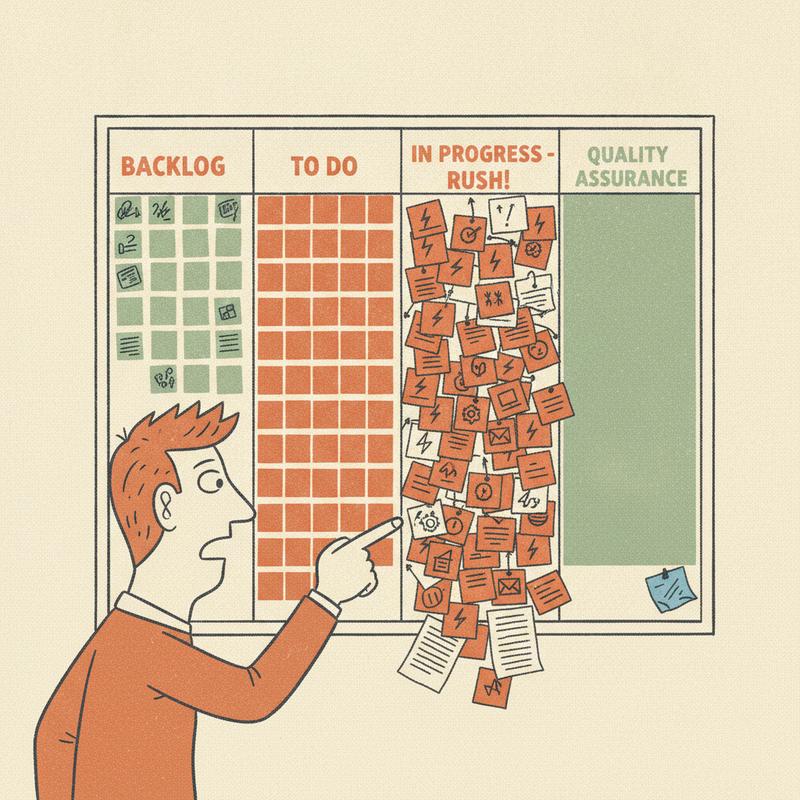
Quality is a value until the quarter-end demo. Then quality becomes a suggestion, and everyone learns the real ranking in about four minutes.
You do not announce your values. You reveal them under pressure. Every time.
Three places your real values live
Forget the intranet page. If you want to know what your org honestly believes, look here.
1. The pull request queue
Who gets a rubber stamp and who gets forty comments? If the staff engineer's 900-line PR sails through while a new hire gets picked apart over naming, your value is seniority, not craftsmanship. Nobody wrote it down. Everybody knows it.
Time-to-first-review tells you something too. A PR sitting untouched for three days says collaboration ranks below whatever else people are doing.
2. The on-call rota and the incident review
Post-incident meetings are the cleanest values test I know. Watch the first ten minutes. If the room hunts for a name, your value is blame with a nicer label. If the room hunts for the missing guardrail, your value is learning.
And check who carries the pager. When the people who ship the risky change never wake up for it, you have taught your org a lesson about accountability. It is a bad lesson.
3. The promotion packet
This one is decisive. Whatever gets someone promoted is your actual value system, written in the only ink your team trusts.
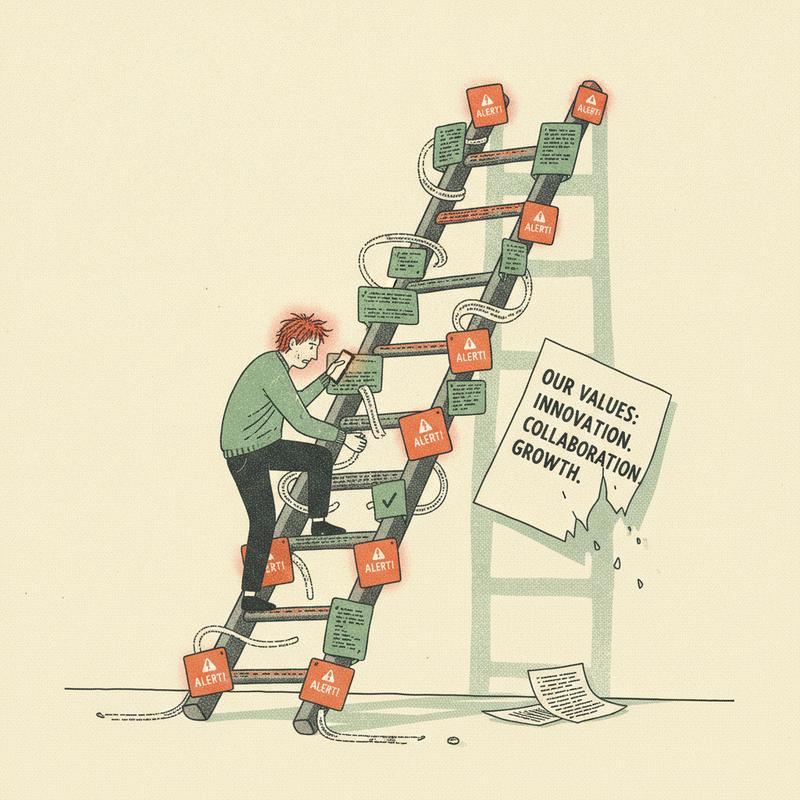
If the last three promotions went to people who shipped visible features fast, then speed-with-visibility is your value. Say it out loud. Own it. The engineer who spent six months deleting dead code and cutting your build time in half took the hint already, and is halfway through an interview loop somewhere else.
The two questions I ask
When I sit down with an engineering team, I skip the culture deck and ask two things.
"What gets you promoted here?"
"What gets you in trouble here?"
Ask five engineers separately. Write down the answers. Compare them with the poster.
The gap between those lists and your published values is your culture debt. Same behavior as tech debt. It compounds quietly, and one day you are paying interest you never budgeted for.
Most teams answer both questions instantly. They have known the answers for months. Nobody asked before.
Values gain teeth when you refuse something
A value earns its place on the wall on the day it makes you give up money, a date, or a person.
Customer focus is a slogan until you slip a launch because the error rate would land on customers. Integrity is a slogan until you turn down a deal your sales lead wants. Respect is a slogan until you exit a high performer who leaves a trail of wrecked people behind them.
The third one is where most orgs fold. We all know the brilliant jerk with the commit history and the body count. Keep them, and every value on your wall goes in the bin at once. Your team watched you choose.
The cost is bigger than morale. MIT SMR's follow-up research found toxic culture was the single best predictor of attrition during the first six months of the Great Resignation, and ten times stronger a predictor than how people viewed their pay. Ten times. You are not retaining the engineer with a comp adjustment. They are leaving because of a person you kept.
Some of my own research points the same direction. In our survey work, 99.5% of respondents said they had experienced one or more types of bad boss. Not a rounding error. A near-universal experience. Every one of those bosses worked at a company with values on a wall.
Fix it in a sprint, not a workshop
Skip the offsite. Try this instead, and run it like an engineering task.
Pick one value. One. The one you would defend in front of your board.
Find the ritual it lives in. Definition of done, review checklist, incident template, promotion rubric, the agenda of your weekly staff meeting. A value with no ritual is a wish.
Instrument it. Track time-to-first-review if collaboration matters. Track the ratio of guardrails-added to people-named after incidents if learning matters. Track how many promotions in the last year went to invisible work if craftsmanship matters. Pick a number a skeptic would accept.
Kill the values with no ritual. Three honest values beat seven decorative ones. Deleting a value you never enforced is the most credible thing you will do all quarter. Your team already knows it was fake. Saying so out loud buys you trust you cannot get any other way.
I work on this problem with leaders through Step It Up HR, and the pattern holds across industries. Gallup's engagement numbers sit around 21% for a reason, and the reason is rarely a wording problem.
The uncomfortable part
Your values statement is already accurate. It describes an organization somewhere. Whether it describes yours is settled by your last five decisions under pressure, not by your last offsite.
So go look at your last five hard calls. The date you slipped or refused to slip. The person you kept or let go. The corner you cut or refused to cut. Write down what those five decisions say about your priorities, in plain language, with no poster nearby.
Then compare it with the wall.
Which list would your engineers say is true?