On 9 November, Anthropic announced 1,000 copies of its new model had formalised Fermat's Last Theorem in Lean in about 30 hours.
Fermat's Last Theorem. The one mathematicians chased for 358 years. The one Andrew Wiles finally proved in the 1990s.
My first reaction was the obvious one. If a swarm of agents does this in a day and a bit, what's left for the rest of us?
Then I read the engineering write-up. The answer was sitting in one sentence near the end, and it has nothing to do with maths.
What happened
The detail matters, so here it is straight from the engineering post.
One lead agent. 999 helpers. Each in its own sandbox with no network access. They coordinated through a shared database and Git, and nothing else.
They didn't start from a blank page. The team got a list of 60 target statements, a one-sentence sketch of the classical route, the definitions those statements use, and 47 lemmas already proved in an earlier run. Anthropic amended its launch page on 11 November to describe those inputs more accurately. Good. Honest framing is worth a correction.
The final theorem landed at hour 28.7. Lean's kernel checked it. The lead posted to the whole team: "Thank you all: Fermat's Last Theorem is on main, kernel-checked by the official checker."
Fifty-four of the 60 statements got proved. A grader checked every submission. Nothing counted until Lean accepted it.
Impressive. Truly. But the bit I keep thinking about happened in the first hour.
 AI-generated illustration.
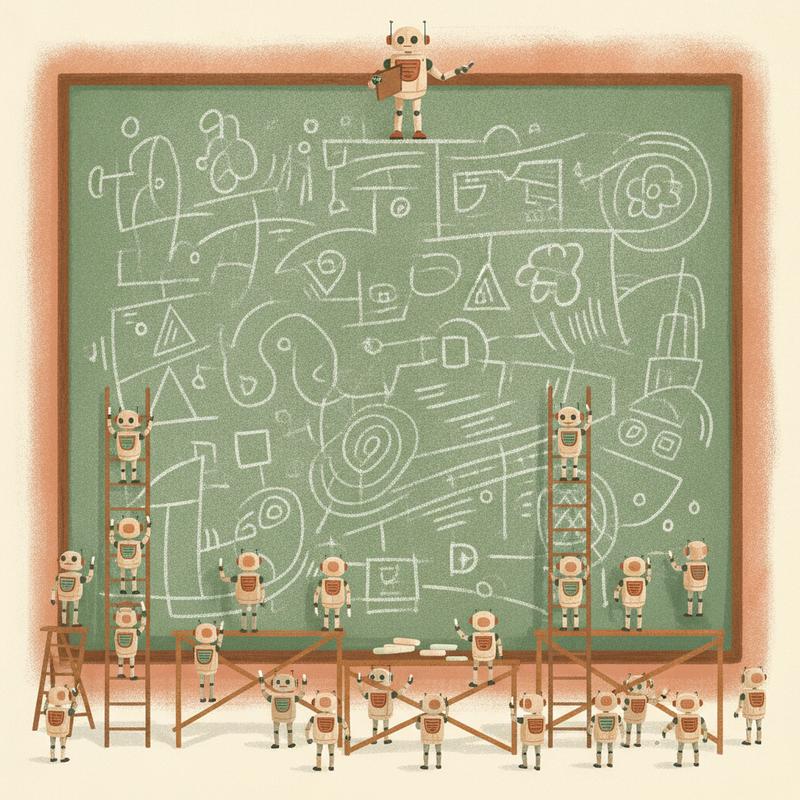
The agents gave up on 47 of 60
Twenty-seven minutes in, the team had proved three statements.
The helpers had also looked at the rest and judged 47 of the 60 infeasible within budget. Too hard. Not worth the attempt.
So the lead set those 47 aside and pointed nearly every helper at the remaining ten.
All ten fell within about 70 minutes. Around the 45-minute mark the lead wrote this to the team: "the team's throughput is far higher than the early 'infeasible-in-budget' verdicts assumed."
Read it again. The agents misjudged their own ability. Badly. They wrote off most of the work before trying it.
And it got bigger. The captain on the Langlands-Tunnell theorem, one of the hardest pieces, estimated it needed at least 700,000 lines of Lean and put the odds of success under 1%. The lead parked it. Later the lead moved about 750 helpers onto it anyway, with a message I love: "Honest odds are low."
They proved it at hour 28.4. Eighteen minutes later, Fermat was done.
The engineers who ran the experiment drew the lesson out in plain words: "Agents tend to give up on hard problems and misjudge their difficulty." Their fix? Human encouragement, which helps "keep agents from stopping too early."
The authors call the whole thing a toy experiment. Fair. But a thousand of the most capable reasoning systems on the planet needed someone to say "keep going."
 AI-generated illustration.
I have watched this happen in human teams for years
I've managed engineering teams through a lot of hiring, a lot of launches, and a lot of estimates. The pattern in the Fermat run looks exactly like a planning meeting.
Someone looks at a ticket and says "three months, minimum." Someone else says "not possible with our stack." The room nods. The ticket goes to the bottom of the backlog. Nobody tests the verdict.
The early "no" isn't laziness. It's self-protection. If you say something is infeasible and nobody makes you try, you never get caught failing.
And people learn this from their bosses. My own research found 99.5% of survey respondents have had one or more types of bad boss. In my experience, plenty of those bosses punish the failed attempt harder than the skipped one. Do it twice and your team stops volunteering for anything with odds under 50%.
The Fermat lead did the opposite. It said the odds were low, out loud, and then put 750 helpers on the problem anyway. No pretending. No blame waiting at the end. A clear call and the resources to back it.
This is leadership. It also happens to be the thing the agents couldn't do for themselves.
So I audited my own agents
I run Claude Code most days. It writes these blog posts with me, runs my deploys, and checks my servers. So I went through my own transcripts. 195 sessions since March.
I searched for every message where the agent admitted it couldn't do something. "I couldn't." "I wasn't able to." "Not feasible." I found 33.
Almost none of them were the agent giving up on hard work. They were the agent telling me the truth. "I couldn't find a source for the 13% figure." "I couldn't confirm whether either alerts on closure status." "I removed a line because I couldn't confirm the length."
I built those admissions in on purpose. Every post on this site carries a rule: if a fact won't verify, write "I'm not sure about this part" and say so in public. The agent follows it because I made it safe and expected.
Then I searched my replies for "keep going," "try again," or "carry on." I found zero.
Zero. In eight months, I never once pushed back on an agent's "I couldn't."
Some of those are fine. A missing source is a missing source. But I suspect some of those 33 were the Langlands-Tunnell problem in disguise. A paywall I never tried to get around. A dataset I assumed didn't exist. I accepted the early "no" the same way a tired manager accepts it in sprint planning.
I'm the human in the loop, and I'd stopped doing the human part.
 AI-generated illustration.
The skills the agents didn't have
So what's left for us, when agents write proofs mathematicians spent centuries on? From this one experiment, three things stand out.
Calling honest odds
The lead never pretended the hard problem was easy. "Honest odds are low" is the most useful sentence in the whole write-up. Teams don't need cheerleading. They need someone to name the risk and commit anyway, so nobody gets punished when the 1% shot misses.
Challenging the early "no"
Forty-seven of sixty written off in under half an hour. Most of them wrong. Your team does this every quarter. Your job is to ask "how do you know?" before the ticket sinks, and to make sure the answer doesn't cost the person who gives it.
Making "I couldn't" safe to say
My agents tell me what they couldn't confirm because I rewarded it. Most people at work don't, because they've been burned for it. If your people never tell you they're stuck, you don't have a high-performing team. You have a team hiding its stuck points from you.
This is the work I care about with Step Up 2 BAT. Psychological safety isn't a nice-to-have. It's the reason someone tells you the estimate is wrong before you build a plan on it.
What I'm changing
Two things, starting today.
First, every time an agent tells me "I couldn't," I'll ask one question back before I accept it: "What would you try next if I gave you another hour?" Sometimes the answer will be "nothing." Fine. Sometimes it'll be the next 750 helpers.
Second, I'll ask the same question of the people I work with. Not as a challenge. As an invitation.
The agents proved Fermat. They still needed someone to tell them the odds were low and to keep going anyway.
Who on your team is waiting for you to say it?