Here's a test I've started running on myself after important conversations.
Did anything I believed shift, even a little?
If the answer is no, I wasn't listening. I was waiting. Polite, attentive waiting, with good eye contact and the right noises. Still waiting.
When Grace Judson joined Debra and me on Corey-osity Unleashed, we talked about humility and about listening to views different from your own. Grace has over 25 years in the corporate world behind her and now coaches leaders. The idea I took away from our chat is simple and uncomfortable. Real listening means you're willing to walk out of the conversation as a different person from the one who walked in.
Most of us never sign up for those terms.

Listening without the risk is theatre
I wrote a while back about how being in the room isn't listening. Attention matters. Put the phone down, look at the person, ask a real question.
Attention is the entry fee, though. You pay it and still keep the door locked.
Here's how the locked door sounds in practice:
- "Great point. Let's take it offline." (It never comes back online.)
- "I hear you." (Followed by the original plan, unchanged.)
- "Thanks for the feedback." (Filed, closed, forgotten.)
- Asking for input on a decision you made last Tuesday.
Every one of those sounds like listening. None of them carries any risk for the listener. The person talking does all the exposing. The boss does all the deciding. Your team works this out fast.
Rogers saw this in 1951
Carl Rogers, the psychologist behind client-centred therapy, gave a talk in 1951 called "Communication: Its Blocking and Its Facilitation." It later went into his book On Becoming a Person. The Marginalian has a good write-up of it.
His argument: if you truly understand another person's view, from the inside, without rushing to judge it, "you run the risk of being changed yourself."
He didn't present this as a nice side effect. He presented it as the reason most people avoid real understanding. Changing is scary. Staying certain feels safe. So we listen with one hand on the door handle.
Rogers offered a rule to break the habit. In a heated discussion, nobody gets to make their own point until they've restated the previous speaker's ideas and feelings well enough for the speaker to agree with the summary.
Try it in your next tense meeting. It's humbling. You find out how often you'd built your reply before the other person finished their first sentence.
What the research says happens when people feel heard
Here's the part I find convincing. Listening isn't a soft courtesy. It changes outcomes.
Avraham Kluger, Guy Itzchakov and colleagues ran a meta-analysis of listening at work, published in the Journal of Business and Psychology in 2023. They pulled together 664 effect sizes from more than 400,000 observations. Feeling listened to correlated with better work outcomes across the board (r = .39), with the strongest link to relationship quality (r = .51). They flag a real weakness... most of the studies rely on self-reports. Even after stripping those out, listening still tracked with job performance.
A 2025 meta-analysis by Elisa Vogel and John Gastil looked at 50 studies and 9,601 people. Feeling heard had a significant effect on every outcome they measured. The biggest effects showed up in how the speaker saw the listener, especially trust (r = .68). And the effects were stronger in workplace settings than in political ones.
So the numbers say feeling heard builds trust. Now ask yourself what makes someone feel heard. Nobody feels heard by a person who nods, smiles and changes nothing. People feel heard when something they said lands and moves.
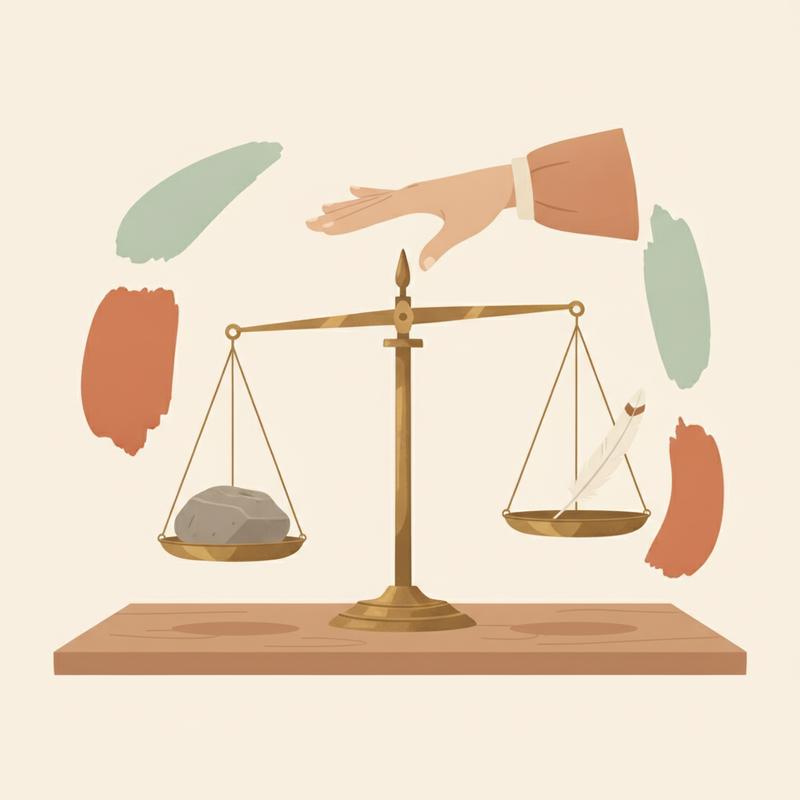
Safety runs both ways
Itzchakov and Kenneth DeMarree wrote a 2022 review in Frontiers in Psychology on psychological safety and attitude change. Their point: when people feel psychologically safe, they get more open-minded, more reflective, and less defensive. Attitudes shift, even with nobody trying to persuade anyone.
Most leaders read research like this and think about their team. Make them feel safe, and they'll open up.
Turn it around. When do you feel safe enough to change your mind in front of your team? If the answer is "never," look at what you've built. A culture where the boss never moves is a culture where the boss never feels safe being wrong. Everyone else picks up on it.
I learned this one the hard way. I wrote about the day I was wrong in front of my boss's boss. Owning it in the room did more for my reputation than any of the times I'd been right.
Why leaders lock the door
I don't think most bosses refuse to change out of arrogance. I think they're scared.
There's a belief buried deep in a lot of leadership training... the boss is paid to know. Changing your mind looks like weakness. Admitting someone junior spotted something you missed feels like losing status.
My own research for Step It Up HR found 99.5% of survey respondents had suffered at least one type of bad boss. One of the bad boss types we describe is the Ignorer... the boss who asks for input and does nothing with it. You'll find more on the bad boss types at Step It Up HR.
Grace wrote a whole book, The Five Deadly Shoulds of Office Politics, about the "shoulds" we carry around at work. "A leader should have the answer" is one of the heaviest. Put it down. Your team doesn't need you to be right on the first try. They need you to end up right, and to bring them along on the way.

How to listen like you mean it
None of this needs a training budget. It needs nerve.
Name what you think before you listen
Before an important conversation, write down your current view in one sentence. Afterwards, look at it again. Did it move? If it never moves, either you're always right (you're not) or you're not listening.
Restate before you reply
Use Rogers' rule. Summarise what the other person said, including how they feel about it. Ask, "Have I got it right?" Only make your point once they say yes.
Ask the question you're afraid of
"What am I missing?" "Where would this plan fail?" "What would you do differently?" Then stop talking. Sit in the silence. Somebody will fill it.
Change something visibly
When someone's input shifts your thinking, say so in public. "I was going to do X. After talking to Priya, we're doing Y." Nothing teaches your team their voice matters faster than watching it move a decision.
Say "I don't know" out loud
I've been saying this for years, going right back to one of the first posts on this site. It still holds. "I don't know, help me think it through" invites people in. Certainty shuts them out.
The test
Next time you finish a one-to-one, a team meeting, or an argument at home, ask yourself one question.
What do I believe now, and didn't believe an hour ago?
If the answer is "nothing," you heard the words. You didn't listen.
When did someone last change your mind? And when did you last let them see it happen?