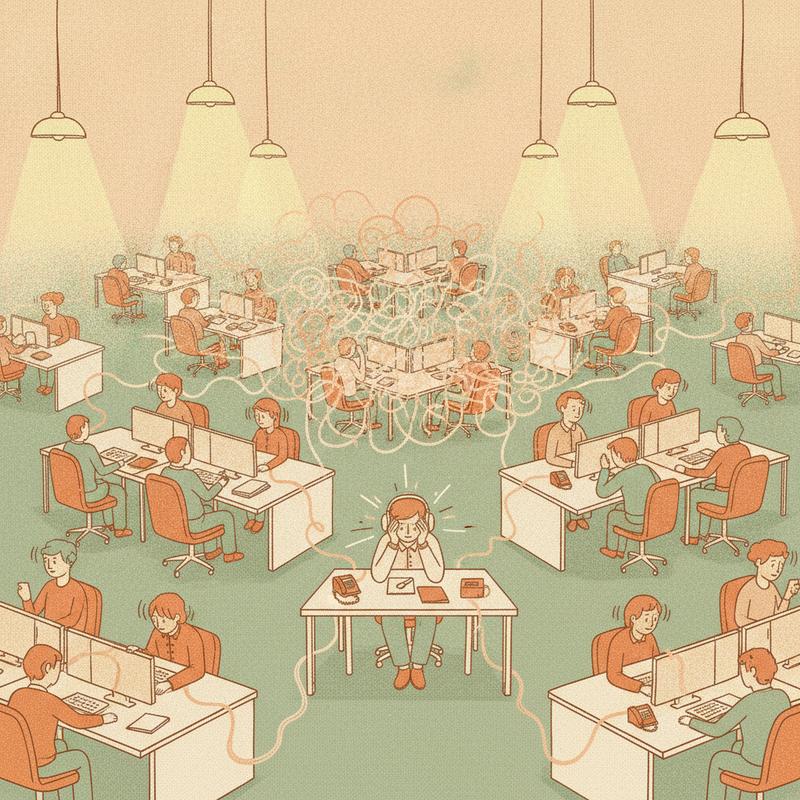
You've met this employee. Brilliant on paper. Sharp in a one-on-one. Then they spend a week in the open-plan office and fall apart by Thursday. Missed details. A short fuse. A calendar full of meetings they leave more tired than when they walked in.
The usual response is a performance conversation. A development plan. A course on "resilience." Every one of those moves points at the person.
Gillian Jones-Williams has a line for this I keep coming back to. Don't fix people. Fix the climate.
The Person Isn't the Broken Part
Gillian is an executive coach, the author of 50 Top Tools for Coaching, and a guest on my podcast, Corey-osity Unleashed, earlier this year. Writing for Kogan Page in January, she put the whole problem in one sentence:
"Every single person has strengths in different ways, but they may not display them if the environment is unconducive."
She names the usual suspects. Open-plan offices. Calendars crammed with meetings. Even the commute, which leaves some people dysregulated before the first task of the day. And she makes a point I wish I'd heard twenty years ago. Most people won't bring any of this up "unless they are asked and feel safe to discuss it."
Here's the trap. When someone struggles in an environment built for a different kind of brain, the struggle shows up as a performance problem. So we manage the performance. We never touch the environment.
What the Numbers Say About the Room
The CIPD surveyed 1,003 employers and 1,047 employees for its 2024 Neuroinclusion at Work report. A few of the findings stuck with me.
Neurodivergent employees were far more likely to say they feel exhausted at work. 45% said so always or often, against 30% of their neurotypical colleagues. Same jobs. Same offices. A different bill at the end of the day.
Only 38% of employees said their organization gives meaningful support to neurodivergent people.
Now look at the managers. Employers said only 46% of their managers feel capable and confident supporting neurodivergent people. Only 18% of organizations train managers on how to respond when someone tells them they're neurodivergent. And only 28% design line manager roles to give enough weight to managing people at all.
Put those three together. Most managers have no training, no confidence and no time. Of course they reach for the fix-the-person playbook. It's the only one anybody handed them.
I wrote about one slice of this a couple of weeks ago in Brainstorming Isn't Neutral, where the format of a meeting filters out good ideas before anyone hears them. The brainstorm is one room. Your whole workplace is a building full of them.
Fixing People Has a Cost
In 2023 the UK government launched the Buckland Review of Autism Employment. Sir Robert Buckland's foreword includes a number worth sitting with. Only 3 in 10 autistic people of working age are in employment.
The review goes further. Autistic people face the largest pay gap of any disability group, earning a third less than non-disabled people on average. Autistic graduates are twice as likely as non-disabled graduates to be unemployed 15 months after finishing, and only 36% find full-time work in the same period.
These aren't people short on talent. These are people whom interview formats, office layouts and management habits shut out, because somebody else was the design brief.
Gillian points at a quieter cost too. "Most neurodivergent people have spent their life masking," she writes. Masking means hiding how your brain works so you blend in. It burns energy all day, every day. Look at the 45% exhaustion figure again with this in mind. It stops being a mystery.
Every time a manager responds to a struggle with "try harder" or "be more like the others," they add to the mask. The person gets better at hiding. The work doesn't get better. And one day the person leaves, and the exit interview says "personal reasons."
Climate Is a Manager's Job

Think about a windowsill full of plants. A cactus, a fern, a climbing vine. Nobody sensible prunes the fern for wilting in full sun. You move it, or you drop the blind. You change the conditions and the plant does the rest.
Most of us treat the workplace as fixed. The office is the office. Standup is at 9:30. The sprint review is a big room with everybody talking at once. If someone struggles inside those walls, we look at the person.
The climate isn't weather. You set it. Every meeting you schedule. Every channel you open. Every unwritten rule about cameras on, instant replies and who speaks first. Those are your choices, and you're free to change them.
I'll be honest about my own gaps here. In 2024 I signed up for a workshop called "Embracing Neurodiversity at Work: Practical Tools for Managers," because after years of running teams I knew I didn't have those tools. I'd guess most managers reading this haven't had an hour of training on it either. The CIPD numbers say 27% of organizations offer line managers any training on what neurodiversity is and why it matters to the business.
There's one hopeful number in the report. 73% of employers say they encourage managers to get to know people as individuals: what they're good at, what they enjoy and what they find hard. The encouragement exists. The habit doesn't. Yet.
The Curb Cut Effect

Here's why this is worth doing even if nobody on your team has told you a thing.
Cities first cut ramps into curbs for wheelchair users. Then parents with strollers used them. Delivery drivers with hand trucks. Travelers dragging suitcases. Today almost nobody thinks of a dropped curb as a disability feature. Angela Glover Blackwell wrote about this in the Stanford Social Innovation Review as the curb-cut effect. A change made for one group ends up helping everyone.
Workplace climate works the same way. Agendas sent the day before. A quiet room nobody has to book. Meetings with a clear purpose and a hard stop. A written way to contribute for people who think best on their own. Clear written instructions alongside the spoken ones. Nobody needs a diagnosis to benefit from any of it.
And you won't always know who needs it most. Plenty of people never tell their manager, for reasons I covered in the brainstorming piece. Design the room well and you help them without making them ask.
Ask the Question Nobody Asks
Gillian has a warning for well-meaning managers. "The old adage of 'putting yourself in their shoes' doesn't work in this situation," she writes. You won't predict what gets in someone else's way. Your shoes don't fit their feet.
So stop guessing and ask. Her suggestion is a clean, open question with no assumption baked in: "What does good look like for you?"
Here are a few more I'd bring to your next one-on-one:
- When during the day do you do your best thinking?
- Which of our meetings drains you the most, and why?
- Do you prefer instructions written down, spoken, or both?
- What's one thing about our office or our tools you'd change tomorrow?
Ask everyone, not only the people you suspect. Asking everyone keeps it normal and keeps nobody on the spot.
Then act on the answers. A question with no follow-through teaches people to stop answering. If you hear "the Monday all-hands wrecks my morning," move it, shorten it or offer the recording. If you hear "I lose track when instructions come in a hallway chat," put them in writing. Small changes. Big signal.
Start With the Room on Monday
You won't redesign the office this week. You don't need to.
Pick one recurring meeting. Send the agenda a day early. Give people a written way to add to it. Then watch who speaks up who didn't before.
The next time someone on your team struggles, before you book the performance conversation, ask yourself one question. Is the problem the person, or the room you built for them?