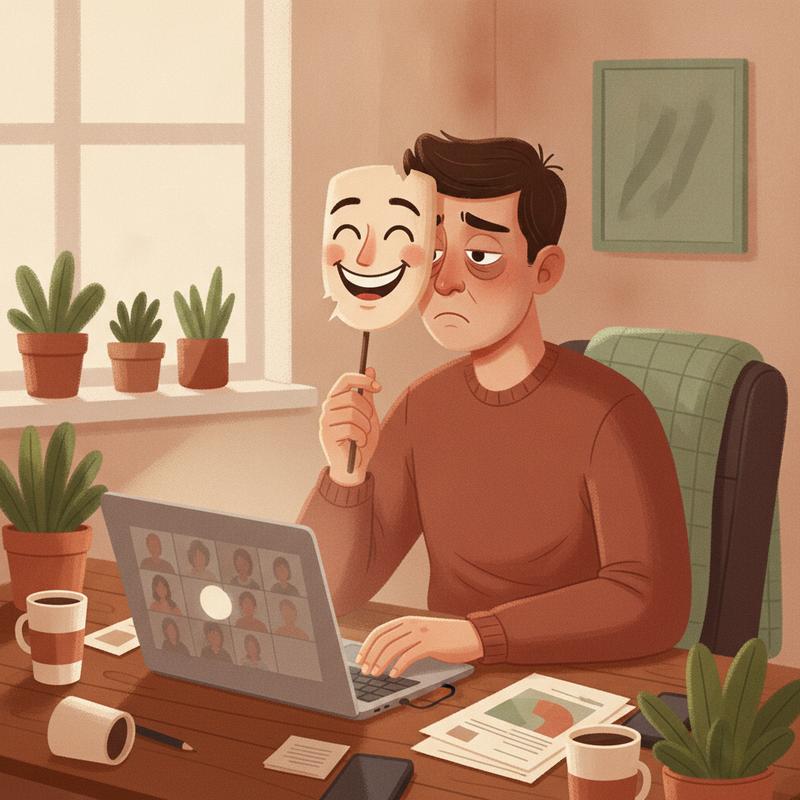
About 25 faces on a call. First lockdown. The person running it goes around the grid with one question... how are you feeling?
"Great." "Great." "I'm doing great."
Then it reached my wife Debra, and Debra gave a different answer: "I'm doing shit."
No speech. No moaning. Nobody on the call knew what was going on, and Debra said so out loud. The meeting turned. People stopped reporting how great everything was and started asking what they might do to help themselves feel better.
One honest sentence changed the agenda of a 25-person meeting. I keep thinking about why.

My part in this story
Debra told this on Corey-osity Unleashed when we had Ian Pettigrew on the show. Ian wrote Hope Is a Strategy and studies hope for a living. Ian's response: Debra had "created the conditions for other people to open up."
Here's what I did next. Debra asked if we should move to the next question. I said, and the transcript keeps the receipt: "I'm looking at the clock. We need to pick up our pace."
Best story of the episode, and I hurried us along. I once wrote a whole post arguing hurry and care don't live in the same room. So there's your first lesson. Knowing this stuff and doing it are different skills.
Everyone thinks they're the odd one out
I doubt all those people were doing great. Lockdown had started. Nobody knew anything. So why did the round come back with a wall of smiles?
Psychologists call it pluralistic ignorance. Prentice and Miller studied it in college students and campus drinking back in 1993. Across four studies, students believed they felt less comfortable with the drinking than the average student did. The average student was thinking the same thing. The feeling of being an outlier tracked with feeling alienated from campus, even though the difference was an illusion.
Jordan and colleagues took the idea closer to our call. In four studies, people underestimated how much negative emotion their peers felt and overestimated the positive, even with peers they knew well. Part of the reason: those peers hid it. People who guessed lowest about the bad feelings of others reported more loneliness, more rumination, and lower life satisfaction. Those are correlations, so I won't claim the guess caused the misery. I will claim the mechanism sounds familiar.
Run it on a video call. You feel awful. You hear "great" from the first person, and now you've got one data point. You hear it from the second and third, and now you've got a norm. Each "great" raises the price of the next honest answer. By the time the question reaches you, the room has voted, and you vote with it. Your "great" then becomes evidence for the next person in the grid.
Nobody in this picture is a liar in any serious sense. Everyone is reading the room, and the room is everyone else reading the room.
"Fine" is the default setting
This goes well beyond one call. In 2018 the UK campaign Time to Change surveyed 2,000 people. According to Metro's report, 78% said they'd told people they were fine while struggling with low mood, anxiety or other mental health problems. Over half worried people wouldn't want to hear the honest answer.
I'm not sure about this part: I only found the survey through press coverage, not the original data, and Time to Change closed in March 2021, so treat the 78% as a campaign number and not as a research finding.
Read the second number again. Over half of them had predicted a lack of interest from the person asking. And when your manager asks "how are you?" while scrolling through the next slide, they've got evidence for the prediction.
The grin costs something
Ian raised Arlie Hochschild's work on emotional labor during the same conversation. Hochschild's idea: some jobs require you to display feelings you don't have, and the display is work. Ian's summary of the trap stuck with me. You're struggling with something. Now you also have to fool yourself about it. Then you have to fool everybody else. Three jobs where you started with one.
Hülsheger and Schewe pulled together three decades of research on this, 95 studies and 494 correlations. Surface acting, meaning you show what you don't feel, had substantial links to impaired well-being (ρ between .39 and .48) and worse job attitudes (ρ between -.24 and -.40). It had a small negative link to performance as well.
Two warnings. Those are correlations again. And the review covers the emotional demands of work in general, not the five-minute check-in round. I'm not sure about this part: I found no study testing what one honest answer does to a group check-in. Debra's call is one story. The research supports the mechanism, not the size of the effect.
Why Debra's answer worked
Two details matter, and I'd miss both if I only told you the punchline.
First, Debra says there was no moaning and groaning. Debra named the state of things without turning it into a complaint. An honest answer gives the room information. A complaint gives the room a job.
Second, the group picked it up. The conversation moved to what they might do about it. Honesty without a next question is a confession. Honesty with a next question is a meeting worth having.
You also misjudge how it looks from outside. Bruk, Scholl and Bless ran seven studies on what they called the beautiful mess effect. People rated their own vulnerable moments more negatively than they rated the same moments in others. You see weakness in the mirror. They see a person telling the truth.
Now the part the inspirational posters leave out. Rank changes the deal. Gibson, Harari and Marr looked at disclosing weakness to coworkers. Their title says it undermines the working relationships of higher-status people. Among peers, influence, conflict and relationship quality stayed the same. I only reached a summary of this paper, so don't lean on it beyond the headline.
And I've written about the ways this goes wrong from the top. A leader whose hardship is finding private schools during an office move, while staff count train fares, isn't building trust. A boss who opens up to shut you down is running a play. And for the person with no savings and a shaky contract, "speak up" is cheap advice from somebody else's safe seat.
So I won't tell you to go first on your next call and say you're doing shit. Honest answers cost different amounts for different people. Your job, if you run the meeting, is to lower the price.
Fix the round, not the people
Four changes you're able to make before your next team call. These are my opinion, drawn from the above, not a tested program.
Answer first, and answer truthfully. The first answer sets the norm for the whole grid, so don't hand this to whoever's tile sits top left. Check your answer against your audience first. "Three projects moved this week and I don't know how the budget lands" works. Your private school search doesn't.
Ask twice. This was the Time to Change campaign. "How are you?" "Fine." "How are you, though?" The second ask tells people you meant the first one. Do it one to one, phone face down, because nobody owes a second answer to a grid of 25.
Decide what happens after an honest answer. Before you ask the question, know your next line. Mine would be "thanks for saying it... what would help this week?" If you've got no next line, you're collecting feelings as an agenda item. People notice.
Don't look at the clock. I've got the transcript. When somebody gives you the true answer, the meeting you planned stopped being the meeting you need. Five minutes late costs you five minutes. Moving on tells 25 people what honesty earns around here.

Say the true thing out loud
Schroeder and Prentice followed up on the campus drinking work. They ran peer discussions where new students talked about pluralistic ignorance itself. Four to six months later, those students reported drinking less than students who got an individual-focused discussion. Different topic, I know. The bit I'd carry over: telling a group "you're all misreading each other" did something.
So try saying it. "I suspect some of us are not doing great, and we're all assuming we're the only one." It costs one sentence. Debra's cost one sentence too.
Next time the question goes around the grid and you hear great, great, great... ask yourself who in this meeting would pay the most for telling the truth. Then ask what you're doing to bring the price down.