I was in the US Army when I decided my next step was software engineering. No roadmap, no mentor with a whiteboard drawing out my ten-year plan. I walked off a military base and into a completely different life.
Years later, I went from research engineering at Sun Microsystems to managing mobile banking at Santander. From there, I led seven engineering teams at a fast-moving fintech in London. And then ... most confusingly to everyone I told ... I became Chief Innovation Officer at an HR company and co-wrote a book about bad bosses.
On paper, my career looks like someone knocked a plate of spaghetti onto the floor.
I wouldn't have it any other way.

The Lie We Tell Young People
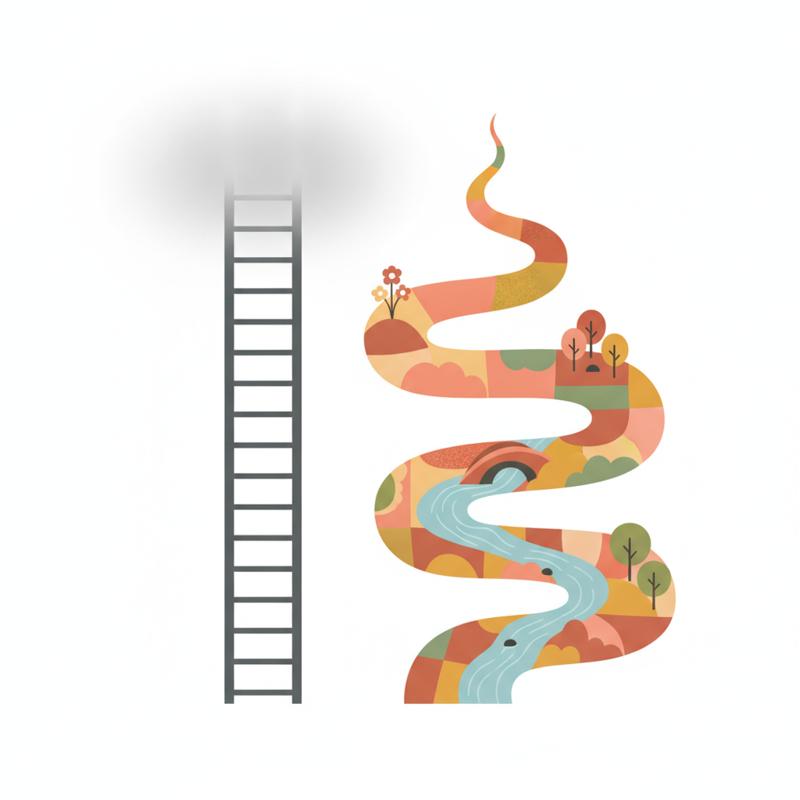
Somewhere along the way, we decided careers were supposed to work like ladders. Pick a rung, keep climbing, don't look sideways. Get a plan ... a real one, a ten-year one ... and stick to it.
This advice has ruined more careers than bad managers have.
The ladder model assumes the world is static. It assumes the job you want at 22 will still exist at 32. It assumes you know yourself well enough at graduation to choose a direction and never deviate. None of those assumptions hold.
What makes this worse: the companies who told us to be loyal, to stay on the ladder, to sacrifice other opportunities for the sake of the plan ... they never offered the same loyalty back. Layoffs, restructurings, pivots, acquisitions. Companies change shape all the time. The deal was never as stable as it sounded.
We tell young people to pick their passion and pursue it. What we're telling them is: make a high-stakes, permanent-feeling decision about who you are before you've had enough experience to know either of those things.
This isn't ambition. It's anxiety dressed up as planning.
What the Numbers Say
Research from the University of Queensland puts the average number of distinct careers at three to seven before retirement. Not jobs. Careers. The average person changes jobs roughly every two years and nine months. Over a 45-year working life, this adds up to around 16 different jobs.
Sixteen.
CVWizard's 2025 data found 66% of Gen Z workers planned to switch jobs within the year. Not careers ... jobs. And the number was even higher among Gen Z women at 71%.
This isn't failure. This isn't lack of commitment. This is how careers work now. And if we're honest about it, how they've always worked.
The ladder was never real. It was a story companies told employees to make them feel stable, and a story employees told themselves to feel in control. The spaghetti was always there underneath.

The Real Cost of Ladder Thinking
When people believe their careers should go in a straight line, any deviation feels like failure.
I've coached engineers who felt genuine shame about moving into management, as if going sideways meant giving up. I've spoken with managers stuck in roles they hated because leaving their industry felt like starting over. I've met people in their forties who'd never tried anything new because they were afraid of falling off a rung they'd spent twenty years climbing.
The ladder doesn't free you. It traps you.
It creates a permanent state of behind-ness. If you're not on the next rung yet, you're late. If you spent a few years in a different direction, you're off track. If you tried something and it didn't work, you've wasted time.
None of this is true. It is, though, exhausting to believe.
There's also a quieter cost nobody talks about: the skills you never build because you were focused on moving up instead of moving around. The relationships you never make because you stayed inside one industry. The perspective you never gain because you only ever saw one type of problem.
The ladder keeps you narrow. The spaghetti makes you broad.
Why the Messy Path Wins
The more varied your path, the more resilient you tend to be. Not because variation is inherently good, but because every sideways move adds a new set of skills, contexts, and perspectives to your toolkit.
My time in the Army taught me how to lead under pressure, how to give and receive direct feedback without ego, and how to function in high-stakes environments with incomplete information. None of it showed up on my resume in an obvious way. All of it transferred to every role I've held since.
My move from fintech to HR consulting looked strange from the outside. What do engineering teams have to do with employee experience? As it turns out: everything. The hardest problems in software aren't technical. They're human. I spent fifteen years solving them from the engineering side. Now I solve them from the people side. Writing a book about bad bosses wasn't a departure from my career in tech. It was the logical result of spending fifteen years watching management go wrong in organizations built on code.
The context from one world makes you sharper in the next. You don't get it by staying in your lane.
The best leaders I know have careers like mine ... messy, multi-industry, full of moves no one predicted. They're not better leaders despite the wandering. They're better because of it.
How to Stop Thinking in Ladders
This isn't an argument for changing jobs every six months. Spaghetti isn't chaos. It's a tangled path getting you somewhere interesting.
Here's how I think about it:
Follow the problem, not the industry. The question I've always asked: where is the hardest, most interesting version of this problem? If the answer is in a different sector, go to a different sector. The skills transfer. The industry label doesn't define you.
Value the adjacent move. A sideways step into a role teaching you something new is worth more than a promotion into a role teaching you nothing. Rank and title are the ladder model's currency. You don't have to trade in it.
Stop measuring by comparison. The ladder model is inherently competitive ... who's ahead, who's behind, who got there first. The spaghetti model makes comparison nearly meaningless. Your path is yours. Stop checking where other people's pasta landed.
Own the story. Every pivot, every change, every unexpected move builds a narrative. The narrative isn't "I had no plan." The narrative is "I followed what was interesting and ended up with experience most people don't have." Own it.
Know what you're running toward, not away from. A career change driven by curiosity is a healthy thing. A career change driven by fear of honest self-assessment is a different thing. Know the difference.
The Plan Is Overrated
I'm not saying skip planning altogether. I'm saying don't confuse a plan with a script.
A plan gives you direction. A script demands you follow it regardless of what you learn along the way. The first is useful. The second is limiting.
The best thing I ever did for my career was stay curious about problems well outside what I was supposed to be working on. Curiosity took me to an Army base. To a research lab. To a fintech startup. To an HR company. To writing a book. To building something new.
I don't know where the path leads next. I'm genuinely looking forward to finding out.
Your career isn't supposed to be a ladder you climb toward a destination someone else defined. It's a plate of spaghetti ... tangled, surprising, and much better when you stop trying to make it go straight.
What's the most unexpected move you've ever made in your career?