Ian Pettigrew brought up a scene from the Fyre Festival documentary, and I haven't stopped thinking about it.
The festival is weeks away. Billy McFarland has promised free beach houses to every influencer who posts about the event. There are 250 influencers. The houses don't exist. His festival consultant tells him the plan won't work.
According to NME's write-up of the Netflix film, the answer comes back: "We're not a problem-focused group. We're a solutions-oriented organisation. We have to keep a positive attitude."
You know how the story ends. Guests paid hundreds or thousands of dollars for luxury villas and gourmet meals. They got disaster-relief tents and cheese sandwiches in foam boxes. McFarland pleaded guilty to wire fraud and got six years in prison.
Fyre is an extreme case. The sentence at its center is not. Most of us have heard some version of it at work.
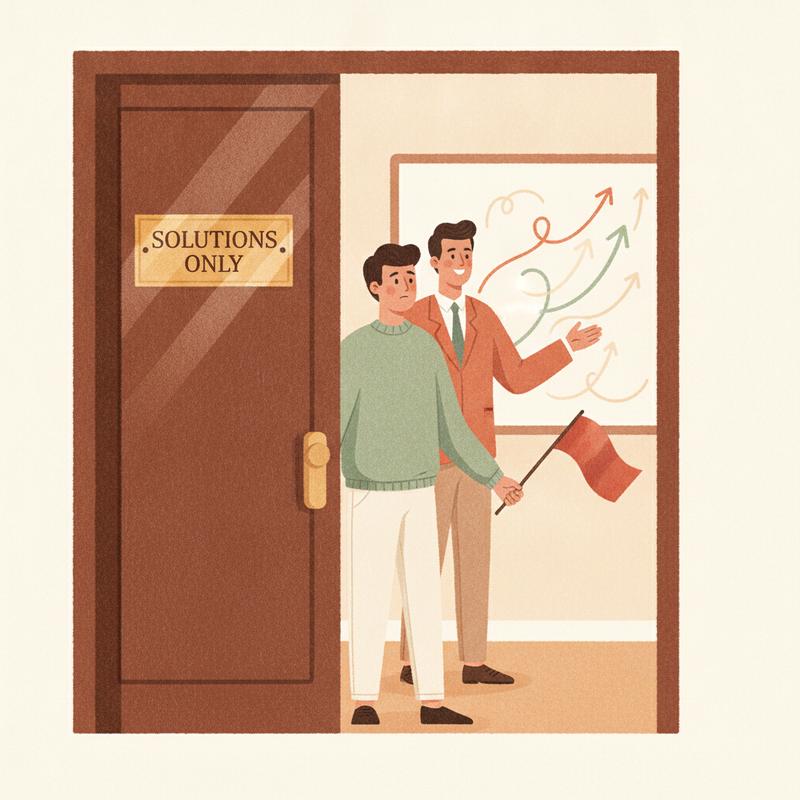
"Don't bring me problems. Bring me solutions."
Why managers love this rule
I understand the appeal. Most managers who say it mean well.
You're busy. People keep walking in with complaints. You want them to think before they talk. You want to grow problem-solvers, not people who dump work on your desk and leave. The rule sounds like coaching.
It also feels efficient. One rule, and half your interruptions go away.
They do go away. And there's the problem.
What the rule teaches your team
Your team hears something different from what you said. You said "think it through first." They heard "don't come in here unless you've fixed it."
Researchers have a name for this. In 2011, James Detert and Amy Edmondson published a study on implicit voice theories... the unwritten rules people use to decide when speaking up is too risky. Across four studies, they identified five of these beliefs. One of them is a belief you need solid data or solutions before you speak up. Unless you've got the fix, keep quiet. The paper has been cited close to a thousand times, and later studies keep finding the same five beliefs in other countries and industries.
The others on the list: your boss sees your concern as a personal attack, don't go over your boss's head, don't embarrass the boss in public, and speaking up hurts your career.
Look at those five again. "Bring me solutions" isn't a neutral productivity tip. It's one of the five reasons people stay silent. You're writing it into policy.
The filter catches the wrong things
Here's what the rule does in practice. It sorts problems into two piles.
Pile one: problems the person is able to solve alone. These come to you with a neat fix attached. You approve it. Everybody feels good.
Pile two: problems nobody at their level is able to solve. The budget is wrong. The deadline is fiction. The client promised something the system won't do. The beach houses don't exist.
Pile two never reaches you. The person has no solution, so by your own rule, they have nothing to say.
Pile two is where your company dies. The problems with no obvious fix are the ones you, with your authority and budget and view of the whole board, are paid to handle. You built a filter, and it removes exactly the information you need most.
The festival consultant knew. He had no solution, because there wasn't one. Building villas on an island with no infrastructure in a few weeks wasn't a puzzle waiting for the right idea. It was a reason to cancel. "Solutions only" made cancellation unspeakable.

Engineers know this one already
If you run a software team, you've already rejected this rule once, in a different form.
Nobody writes "only open a bug ticket if you've attached the patch." You want the bug report from the support agent who doesn't read code. You want the alert from the monitoring system, which has never fixed anything in its life. Detection and repair are different jobs, often done by different people. A healthy system makes detection cheap and fast.
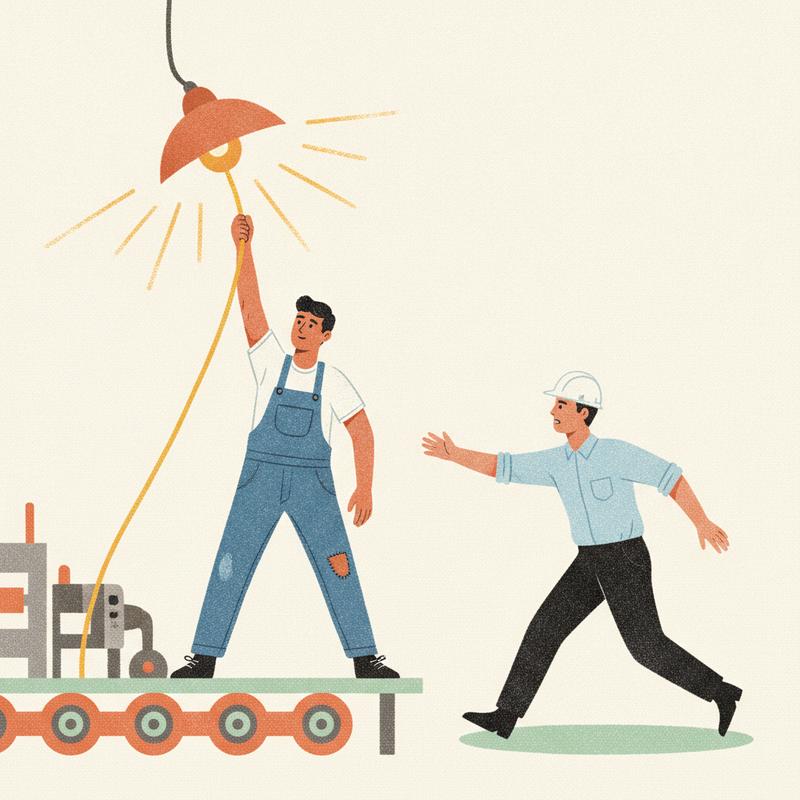
Toyota built a factory around this idea decades ago. On a Toyota line, any operator is allowed to pull the stop cord when they spot an abnormality. The andon board lights up and calls the person in charge. Read it again. The worker who pulls the cord doesn't have to fix the defect. Their job is to stop the line and get help. Fixing it belongs to the people with more context.
It's the opposite of "bring me solutions." Toyota says: bring me problems, fast, and I'll come to you.
I wrote before about how culture is how fast bad news reaches you. "Solutions only" slows bad news to zero for any problem bigger than the person who spotted it.
Positive attitude is not a plan
McFarland didn't only ban problems. He tied the ban to a mood. "We have to keep a positive attitude."
This is where the rule turns from lazy to dangerous. Once raising a problem counts as negativity, the person with bad news isn't only off-script. They're disloyal. I wrote about this in the dark side of always looking on the bright side. Forced positivity doesn't remove problems. It removes the people willing to mention them.
Watch how fast it compounds. The first person who raises a concern gets told to stay positive. Everyone else in the room learns the lesson for free. Nobody else has to get burned. One reply sets the rule for the whole team.
What to say instead
You don't need to drop the instinct behind the rule. You want people to think. Keep it. Change the deal.
Split the problem from the fix
Tell your team: "Bring me problems as soon as you see them. If you have an idea for a fix, bring it too. If you don't, bring the problem anyway." Say it out loud. Say it more than once. Your old rule is still in their heads.
Ask for the size, not the solution
Instead of "what's your solution?", ask "how big is this and how sure are you?" Anyone is able to answer those. You get a sense of urgency without a gate.
Thank the person who pulls the cord
The first person to raise a hard problem sets the price for everyone after. Thank them in front of the team, even when the news ruins your week. Especially then.
Own the pile-two problems
When someone brings you a problem with no fix, it's not a failure on their part. It's the system working. The problem landed on your desk because it belongs there. Pick it up.
Ask what you're not hearing
Go looking. I've written about this in your team knows what's broken. Ask, "What's the problem nobody has brought me because they don't know how to fix it?" Then wait through the silence.
The question to ask yourself
My research on bad bosses found over 99% of people have had at least one. Few of those bosses set out to be bad. Most of them, I'd bet, thought "bring me solutions" was good management.
So check your own door. When was the last time someone walked in with a problem they had no idea how to fix?
If you don't remember, your team hasn't run out of problems. They've run out of reasons to tell you.
If you want help building a team where bad news travels fast, take a look at what we do at Step It Up HR.