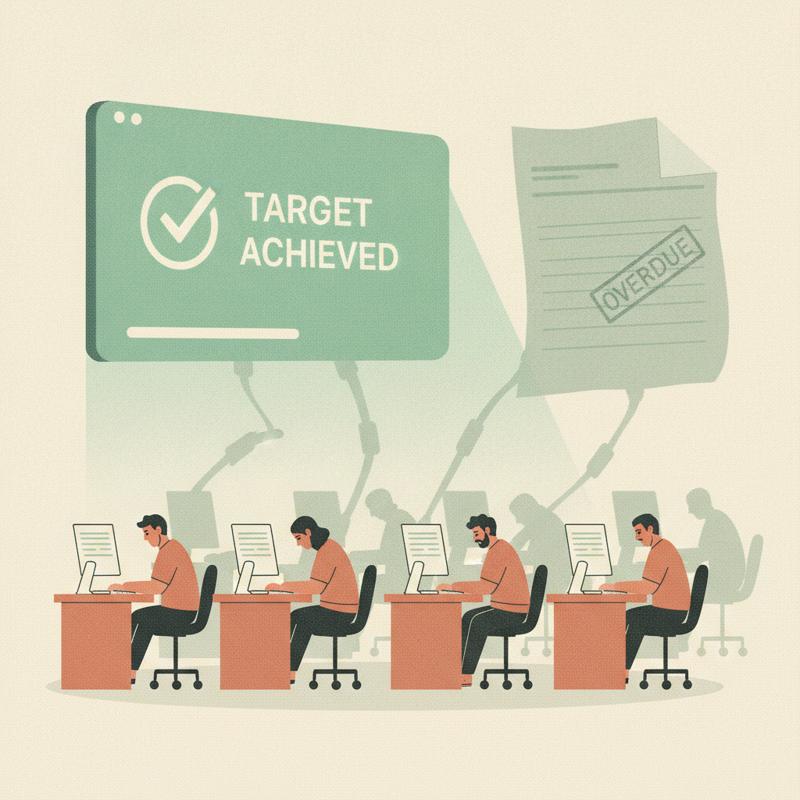
Your team hit the date. The dashboard is green. Your boss sent a thumbs up in Slack.
Now tell me how you got there.
If the honest answer is "I made it clear what would happen if we missed," you didn't win. You borrowed. And the loan comes with interest.
Dan Greene joined me on my podcast, Corey-osity Unleashed, and one idea from our conversation stuck. Hitting numbers while burning people isn't leadership success. It's extraction. I've been chewing on the word "extraction" ever since, because it describes something I did myself as a young manager, and something I've watched dozens of engineering leaders do since.
What Extraction Looks Like on an Engineering Team
Fear rarely announces itself. Nobody stands up in sprint planning and says "I will make you afraid." It shows up in smaller ways:
- A release date set by the exec team, handed down with no discussion of scope.
- "Whatever it takes" said in a tone everyone understands.
- The engineer who raised a risk last quarter and got labelled "negative."
- Weekend work praised in the all-hands, so everyone knows what earns praise.
- A performance review where the only number anyone remembers is the missed one.
None of these feel dramatic in the moment. Put them together and your team learns one lesson. Missing the number is dangerous. Telling you the truth about the number is dangerous too.
So they do what frightened people do. They hit the number by any means available, and they stop telling you what it cost.
The Most Expensive Green Dashboard in History
If you want to see where this ends, look at Wells Fargo.
In September 2016, regulators fined the bank $185 million. According to NPR's report on the settlement, employees had opened more than 2 million deposit and credit card accounts without customer authorisation so they would hit their sales targets. The bank had already fired 5,300 employees over it.
Read the number again. 5,300 people. The bank's first instinct was to call them bad apples. When you fire 5,300 bad apples, you don't have an apple problem. You have an orchard problem.
NPR spoke to former employees about the culture. One described a target of at least eight products a day, rising to 20 a day during a sales push called "Jump into January." "We were all miserable," she said. Walking in every day was "soul crushing." She pushed back. She told her managers there was no ethical way to hit the goals. She called the ethics hotline several times. Wells Fargo fired her in 2011.

Look at what fear did there. It hit the number. The cross-sell metric looked brilliant for years. It also killed the one feedback channel which might have saved the company, because the people telling the truth were the people getting fired.
Then the bill arrived. In February 2018, the Federal Reserve capped the bank's growth, restricting it from growing any larger than its asset size at the end of 2017. The Fed lifted the cap in June 2025. More than seven years of a bank frozen in place, all to keep a scoreboard green.
Your team isn't opening fake bank accounts. I know. But ask yourself what the software version looks like. Tests skipped to make the date. A feature marked "done" with the edge cases quietly moved to a backlog nobody reads. A status report with every box green and a lead engineer who knows it's fiction. Same disease. Smaller scale.
The Maths of Crunch Doesn't Work Either
Some leaders accept the ethics argument and still believe fear works in the short term. Push hard for a few weeks, get the release out, then let everyone recover.
The evidence doesn't back you up.
Evan Robinson wrote Why Crunch Mode Doesn't Work for the game industry in 2005, after the famous "ea_spouse" post about overtime at Electronic Arts. He spent 20 years developing and managing software projects, and he pulled together a century of industrial research. His summary: productivity drops as soon as overtime starts, and "at approximately eight 60-hour weeks, the total work done is the same as what would have been done in eight 40-hour weeks." He also notes crunch creates more bugs.
So two months of crunch buys you nothing. Zero extra output. Plus a pile of defects you now have to fix. Plus a team who now knows what you'll ask of them next time.
Economist John Pencavel found something similar studying munitions workers. His paper The Productivity of Working Hours shows output rises in proportion to hours up to a threshold, then rises at a decreasing rate beyond it. He links the findings to research on long hours and accidents. In software, our accidents are called incidents, and they page someone at 3am.

I'm not sure about this part: Robinson's eight-week figure comes from his reading of older industrial studies, and Pencavel studied factory workers in wartime Britain. I haven't found a modern, controlled study of crunch on software teams specifically. The direction is consistent across everything I've read, but I wouldn't quote you a precise break-even point for your team.
Where the Interest Gets Paid
Extraction never shows up on the dashboard you're watching. It shows up somewhere else, later, on a different line item.
Estimates get padded. Once missing a number becomes dangerous, smart engineers stop giving you honest estimates. They give you safe ones. Your plans get slower, and you never find out why.
Bad news slows down. I wrote about this in Culture Isn't Perks. It's How Fast Bad News Reaches You. Fear doesn't stop problems happening. It stops you hearing about them until they're too big to hide.
Your best people leave first. The engineers with options use them. The ones who stay are the ones who've learned to keep their heads down. You've selected for silence.
Heroics become the job. You start rewarding the person who saved the release at midnight, and you get more midnights. I covered this in Stop Rewarding the 3am Hero.
Burnout gets built in. If your bonus structure pays for the number and nothing else, you've designed the extraction yourself. See You Designed Burnout Into the Comp Plan.
My research for Step It Up HR found 99.5% of survey respondents had experienced one or more types of bad boss. I'd bet a large share of those bosses hit their numbers. Plenty of them got promoted for it. Their teams paid the interest.
How to Hit the Number Without Burning the Team
I'm not arguing against targets. Numbers matter. Customers need releases. Here's what I do differently now.
Separate the date from the scope
When someone hands you a fixed date, negotiate scope out loud, in the room, with your team present. "We'll hit the date. Here's what we'll cut." Fear thrives when the date and the scope are both fixed and the only variable left is people's evenings.
Ask what the number cost
At every retro after a big push, ask one question: "What did hitting this cost us?" Skipped tests, deferred refactors, cancelled holidays, tired people. Write it down. Make the interest visible, because invisible debt never gets paid.
Protect the person with the bad news
The Wells Fargo employee who called the ethics hotline got fired. On your team, the engineer who says "this date isn't real" should get thanked in public. Every time. The first time you punish the messenger, you've lost every future message.
Measure the second dashboard
Track the things extraction hides. Attrition. On-call pages per week. Change failure rate. Hours worked during the last fortnight of a release. If those numbers rise while your delivery numbers look great, you're borrowing.
Run a sustainable pace and mean it
The Agile Manifesto principles say teams should "maintain a constant pace indefinitely." Most teams I've seen treat it as decoration. Treat it as a constraint, the same as a budget. Crunch is a decision you make, so own it and limit it.
The Question for Your Next Green Dashboard
Next time your team hits a big number, before you celebrate, ask yourself two things.
Would they have hit it if they weren't afraid of you?
And will they still be here to hit the next one?
If you don't like your answers, the number wasn't a win. It was a loan. And your team is the one making the repayments.