Everyone is building an AI startup right now.
In 2025, AI companies absorbed $202.3 billion in venture funding... roughly 50% of all global startup capital. Record numbers. And yet the mood in VC circles has shifted from euphoria to something closer to exhaustion.
Because most of what got funded is the same thing dressed up in a different UI.
Take a foundation model. Wrap it in a clean interface. Pick an industry. Raise your seed round. Watch your retention numbers tell a different story.

The Problem With Being Generic
VCs call them "thin wrappers." An AI wrapper startup does one thing: puts a friendly interface on top of an existing model, then sells access to it. The pitch sounds reasonable. The technology is proven. The demo looks good.
The problem is the model belongs to OpenAI, Anthropic, or Google. When those companies improve their models... and they do, constantly... your product either gets better for free or gets made redundant overnight. Neither outcome creates a business you own.
By early 2026, Google and Accel had publicly passed on AI-wrapper-heavy pitches, citing a lack of defensibility. The quote I keep seeing from VCs: "If a small team with an AI coding agent is able to replicate your core product over a weekend, you don't have a venture-backable business."
Generic AI products for low-ticket buyers (under $50 per month) show gross retention of 23% and net revenue retention of 32%. Those numbers are catastrophic. Anything below 80% gross retention is a leaky bucket. At 23%, you're losing three-quarters of your customers every year while burning cash to acquire new ones.
The math doesn't work. The moat isn't there.
Where the Real Moat Comes From
Here's the line I keep coming back to, from a recent post on vertical SaaS strategy:
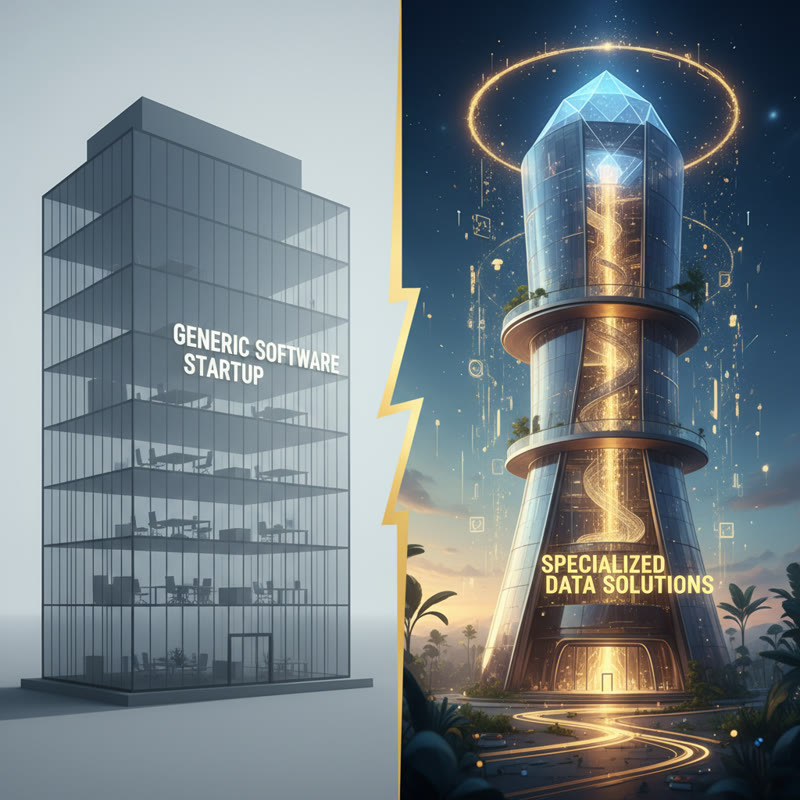
"Your code isn't your moat. Your UI isn't your moat. Your moat is the messy, non-public, highly specific data."
The whole argument, right there.
Vertical SaaS companies win because they accumulate proprietary data no competitor... including the big foundation model companies... possesses. Not generic data. Domain-specific data: ten years of HVAC sensor readings, thousands of anonymous leadership feedback cycles across a specific industry, restaurant transaction patterns across 164,000 locations.
Toast didn't build a $1.9 billion ARR business by wrapping an existing payments API in a clean interface. Toast built it by going deep into restaurants: their workflows, their menus, their labour patterns, their customer behaviour at the table. The data Toast now holds on how restaurants operate has no equivalent anywhere in the world. You are not catching up to Toast by copying their feature list.
ServiceTitan did the same thing for home services businesses: plumbers, electricians, HVAC contractors. $9 billion IPO valuation. Over 95% gross retention. Why does their retention look so strong? Because switching out of ServiceTitan means losing the institutional memory of your business: job history, customer relationships, inventory patterns. The data has gravity.
None of this is luck. It's the natural outcome of choosing depth over breadth from the start.

The Flywheel Compounds
The real advantage isn't static. It gets stronger over time.
Every customer who uses your vertical product generates more domain-specific data. More data makes your AI models better. Better models make the product more useful. A more useful product attracts more customers. More customers generate more data. Repeat.
This is the flywheel. And it's why vertical SaaS retention numbers look so different from generic AI products.
Specialized vertical AI products priced above $250 per month show gross retention of 70% and net revenue retention of 85%. Compare those to 23% and 32% for the generic alternatives. The difference isn't the features. The difference is depth of domain data and the switching cost it creates.
The market reflects this clearly. AI-native enterprise SaaS commands a 41% valuation premium over traditional SaaS. Revenue per employee for AI-native companies reaches $3.48 million, compared to $200,000-$250,000 for traditional SaaS. And the vertical SaaS market reached $130 billion in 2025, growing at 18-22% annually... nearly double the pace of horizontal SaaS platforms.
The companies achieving these numbers are not the ones who built the best-looking dashboard for a generic use case. They're the ones who went narrow and deep, collected data nobody else has, and built systems becoming more valuable the longer a customer stays.
The money is following the moat.
What This Means If You're Building
I'm building StepUp2Bat... a 180-degree leadership feedback tool for managers and their teams. The question I ask myself regularly isn't "what features should I add?" It's "what data am I accumulating no one else has?"
Every feedback cycle on the platform generates patterns: how leaders in specific industries score on specific behaviours, what the gaps look like between self-perception and team perception, what changes after a coaching intervention and what doesn't. Over time, the aggregate of anonymous, structured feedback cycles across organisations becomes a benchmark nobody else holds.
The benchmark is the moat. Not the survey interface. Not the AI summary features. The benchmark.
This matters for two reasons. First, it makes the product more valuable for customers: your feedback data means something when you see how it compares to others in your industry. Second, it makes the business defensible: you are not replaceable by a ChatGPT wrapper with a survey UI slapped on top.
If you're building a software product right now, ask yourself a direct question: what data does your product generate no one else has? If the answer is "none, the model generates everything," you're building on rented land.
The Practical Shift
Building a data moat requires a different set of early decisions.
The first decision is about what data to collect and how to structure it for longitudinal analysis. Raw text and documents are cheap to store. Structured, labelled, domain-specific patterns are expensive to create and impossible to replicate quickly. Invest in the structure early, because retrofitting structure onto a messy data lake is one of the most expensive mistakes a SaaS company makes.
The second decision is about customer contracts. Who owns the aggregate insights from your customers' data? Get this right in your terms of service from day one. Many early-stage SaaS founders don't think about this until a lawyer raises it during a funding round.
The third decision is about going narrow enough. The temptation is always to broaden the target market, because a bigger market sounds better to investors. It isn't. A tight, deep focus on one industry, one workflow, one problem is what creates the data quality leading to a real moat. Generalists get commodity retention numbers. Specialists get the 70% GRR.
There is no shortcut here. The moat is built through years of focused data collection, not through a better GPT-4 prompt.
The Next Two Years
The AI wrapper correction is already underway. VCs stopped funding generic AI wrappers in early 2026. Companies without proprietary data and defensible positioning are expected to fail within 12-18 months as their capital runs out.
What survives is what has always survived: companies with deep customer knowledge, data nobody else holds, and products so embedded in workflow switching means losing institutional memory.
Vertical SaaS isn't new. ServiceTitan and Toast didn't invent this model. What's new is AI making the data collection and analysis layer far more tractable for smaller teams. The companies building now with this discipline will have moats resembling ServiceTitan's in five years.
If you're a founder building a software product, one question worth sitting with: are you building a feature, or are you building a data asset?
The market will answer for you. Better to answer it yourself first.