
There was a period in my career where I wore exhaustion like a medal. I'd drag myself home at the end of a long day, barely able to form a sentence, and I genuinely thought it meant I'd had a good day. Productive. Committed. Serious.
I was wrong.
The Story We Tell Ourselves
The idea goes something like this: if you're not running on empty, you're not working hard enough. Staying late is dedication. Skipping lunch is focus. Answering emails at 11pm is ambition. Being fried by Friday means you gave it everything.
Most of us absorbed this somewhere. Our first bosses modelled it. Our colleagues competed over it. Hustle culture content on social media glorified it. The Army reinforced it for me personally. Work hard, push through, no weakness.
For a long time, I didn't question it. I measured success by how little I had left at the end of the day. If I wasn't tired, had I really tried?
The problem is, it's a lie we've been telling each other for years, and the data is starting to catch up with it.
The Numbers Don't Lie
According to the Mental Health UK Burnout Report 2026, 91% of UK workers experience high or extreme stress annually. One in three regularly works unpaid overtime. Twenty percent took time off due to poor mental health caused by stress. Only 27% feel mental health is genuinely prioritised by their employer.
In the US, Eagle Hill Consulting found 55% of employees are currently experiencing burnout. Gen Z hits peak burnout at 25. Not at the end of a long career. At 25.
We're not working harder and achieving more. We're working harder and breaking down earlier.
Here's the part worth sitting with: if exhaustion were a reliable signal of success, we'd expect those exhausted workers to be the most effective, most satisfied, most impactful. They're not. Burned-out employees are disengaged, unproductive, and leaving. It costs US employers an estimated $5 million per year for every 1,000 employees... and most of it never shows as absence. People show up. They're not really there.
Exhaustion isn't producing results. It's producing wreckage.
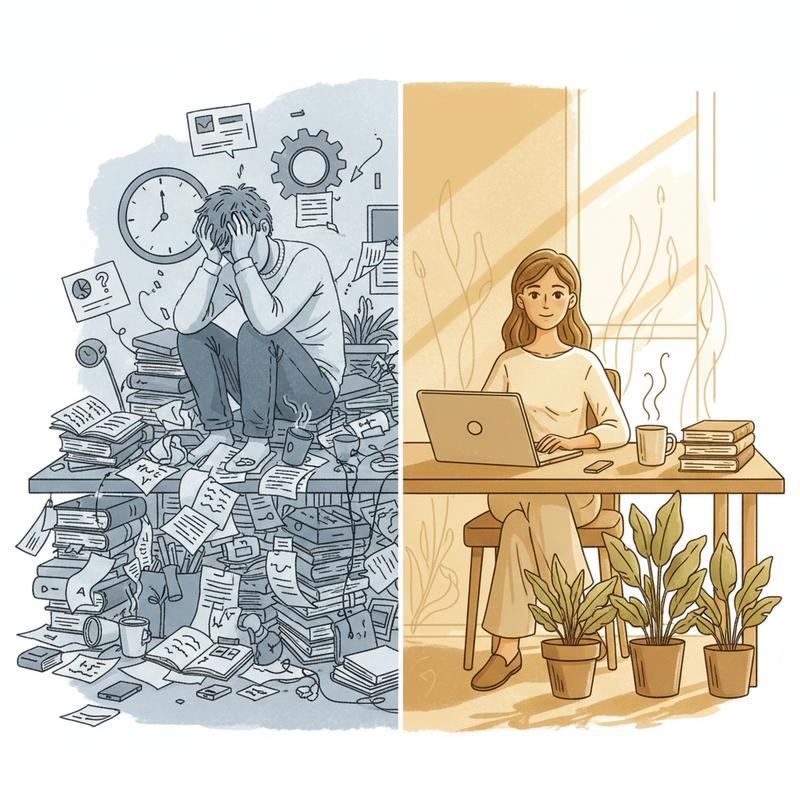
Where I Changed My Mind
I spent years in the US Army before moving into tech. One of the things the Army teaches you is readiness. You don't measure a unit's effectiveness by how tired it is after a mission. You measure it by whether it completed the mission, and whether it's ready for the next one.
Exhaustion compromising readiness for what comes next is a liability. Not a badge.
I carried the readiness principle into my career. For a while, it stuck. But somewhere along the way, tech culture overrode it. The always-on mentality, the late standups, the Slack messages at midnight, the pride in pulling an all-nighter before a launch. I slipped back into the exhaustion-as-success trap without even noticing.
It took a few conversations with people who had clearly defined what success meant for them to shake me loose. One of them put it simply: "I measure a good day by whether I could do it again tomorrow." It landed.
Think about what's in those words. Not "did I stay late enough." Not "did I sacrifice something." Not "did anyone see how hard I worked." The measure is sustainability. Are you able to show up and do it again?
By my own standards at the time, the answer was often no.
Three Signs Your Success Metric Is Wrong
1. You talk about tiredness like it's a competition.
"I'm so tired." "I've been flat out." "I barely slept." If this is your regular vocabulary, and you say it with a hint of pride, your metric is off. Tiredness isn't currency. It's feedback.
2. You feel guilty leaving work with energy.
If finishing at a reasonable hour and still feeling capable makes you anxious... like you should have done more... something is broken. The guilt isn't wisdom. It's a conditioned response to a warped standard. A person who leaves work with energy and got the right things done had a better day than someone who stayed two hours longer out of obligation.
3. Your recovery time keeps growing.
If you need a full weekend to recover from a week of work, and it still doesn't feel like enough, your pace isn't sustainable. Two years ago you felt okay by Saturday. Now it takes until Sunday. Next year it'll take longer. Not high performance. A slow drain.
What Real Success Looks Like
I'm not arguing for coasting. I'm arguing for a better definition.
Real success means you completed what mattered today. You made decisions you're confident in. You treated people well. And you have enough left to show up the same way tomorrow.
It's not about working fewer hours, necessarily. It's about measuring the right things. Did you do quality work? Did you move things forward? Are you able to repeat it tomorrow, next week, next year?

The BBC covered this shift in a piece on the end of rise-and-grind culture: people are re-prioritising what they want from work. Not because they're lazy. Because they've done the maths and the trade isn't worth it.
I see the same thing on Reddit right now. Threads about exhaustion, return-to-office friction, and "is anyone else completely done" type posts are generating enormous engagement. Nobody argues back. People are recognising themselves.
The conversation is shifting. The question is whether you'll shift with it, or keep running a race with no finish line.
What I Changed
A few practical things shifted for me.
I started ending my day with a short review: what did I finish, what needs to carry forward, what was the quality like? It replaced the old exhaustion-check as the measure of a good day. The question shifted from "am I tired enough" to "did I do what mattered."
I stopped responding to late-night messages unless something was on fire. Most things aren't. The culture of instant response trains people to expect it, and then you're trapped. Breaking the habit took a few weeks. Nobody fired me.
I also got deliberate about my own energy... not as a soft concept, but as a practical resource. My best thinking happens in the mornings. I protect this time. No meetings, no email until I've done the work worth doing. Not a luxury. Logistics.
And I started saying, out loud, when things were too much. Not as complaint. As information. "This pace isn't sustainable" is data, not weakness. Leaders who pretend otherwise are lying to themselves and to their teams.
The Question Worth Asking
At the end of today, ask yourself this: do I have something left?
Not so you feel guilty if you're tired. Tired sometimes is fine. Tired always is not.
If your honest answer is "I've been running on empty for months," it's not dedication. It's a system running without maintenance. Worth stopping to ask what you're building, and whether the pace you're keeping is getting you there faster, or getting you there more damaged.
Success should leave you ready for what comes next. Not relieved it's over.