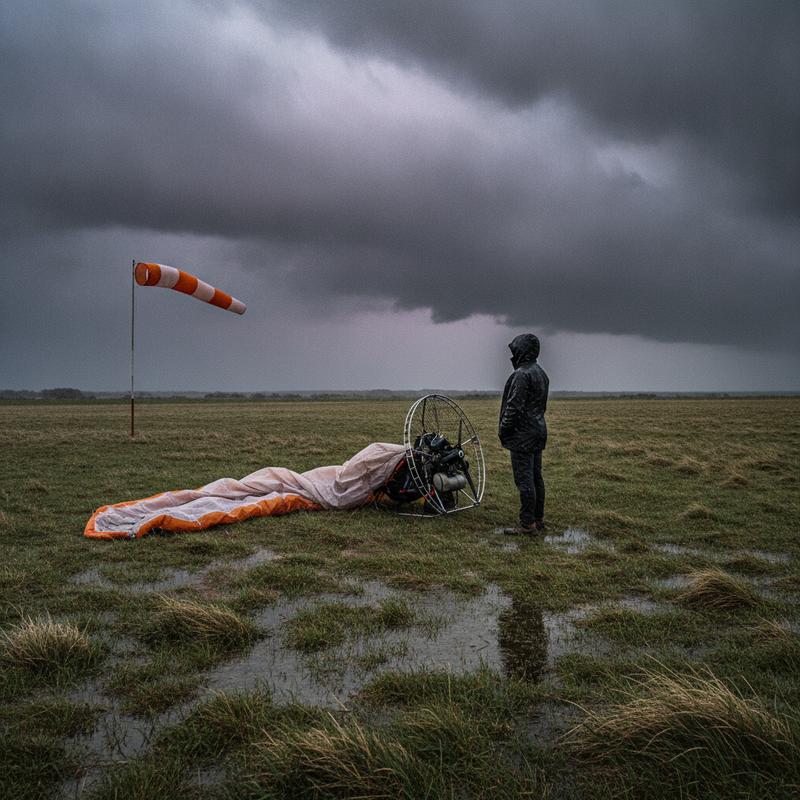
In August 2018 I drove down to Dorset for a week of paramotor training. I'd wanted to fly for years. I had the kit list, the holiday booked, and a head full of daydreams.
Day one went well. We spent most of it on theory, meteorology and reading the land. Then it rained.
The next day was a washout too, so I went sightseeing. On Sunday night the school sent a message to all the students. The forecast showed winds of 8mph gusting up to 45mph. Monday, Tuesday... the whole week. Nobody would fly. Not the students. Not even the instructors.
I had the perfect excuse. I want you to notice something about it. It was true.
The Hope Researcher Started With Excuses
Ian Pettigrew studies hope in leadership. He joined Debra and me on Corey-osity Unleashed (Season 2, Episode 8), and his work led me to an origin story I keep turning over in my head.
The science of hope didn't start with hope. It started with excuses.
Rick Snyder was a psychologist at the University of Kansas. In 1983 he co-wrote a book with Raymond Higgins and Rita Stucky called Excuses: Masquerades in Search of Grace. His research looked at how people explain away their mistakes and poor performances.
Then something odd happened. In his 2002 paper Hope Theory: Rainbows in the Mind, Snyder describes talking with participants after his excuse experiments. They kept bringing up a different motive. They wanted to talk about reaching for positive goals.
He followed the thread. He cast hope as the "other side" of the excusing process, and his first published article on hope, in 1989, carried the title Reality Negotiation: From Excuses to Hope and Beyond.
I love this. A man spent years studying how people wriggle out of things, and his subjects pulled him towards the opposite.
Two Answers to the Same Wall
Here's how I read it. An excuse and hope both answer one question: what happens when you hit a wall?
The excuse protects how you look. It explains why the wall isn't your fault.
Hope looks for a way round the wall.
Snyder defined hope as the perceived ability to find pathways to the goals you want, plus the motivation to use those pathways. He called the two parts pathways thinking and agency thinking. I wrote about the difference between hope and optimism in an earlier post, so I won't repeat it here.
The part of his paper I find most useful is about blockages. According to Snyder, low-hope people tend not to produce alternate routes. High-hope people describe themselves as flexible thinkers, and they turn out to be effective at producing alternative routes... especially when something blocks them. A high-hope person sees a stressor as a challenge. A low-hope person sees it as the end of the road.
Put the two ideas side by side. An excuse is what you say when you see no other route.
The Best Excuses Are True
This is the trap I nearly fell into in Dorset.
We tend to think of excuses as lies. The dog ate my homework. The traffic was terrible. Some of them are lies. Plenty of them aren't.
My weather excuse was airtight. 45mph gusts will kill a novice under a paramotor wing. Nobody on earth would have blamed me for driving home and filing the whole idea under "tried it, didn't work out."
The problem with a true excuse isn't accuracy. The problem is the full stop at the end of it.
"The weather was terrible." Full stop. Conversation over. Goal parked.
Watch what a true excuse does to you. It feels like closure. You've explained the situation, everyone agrees, and the discomfort of wanting something you don't have goes away. The relief is the reason true excuses are so sticky. A lie nags at you. A true excuse lets you sleep.
Hope doesn't argue with the facts. It adds a second sentence.
"The weather was terrible, so where's the weather better?"
What I Did Next
I didn't feel hopeful at the time. I felt flat. On the blog back then I described heading home "with a heavy heart."
Before I left, though, I took credit for the course and rebooked another one for 14 October. In Spain. My reasoning fit in one line: perhaps the weather there was a little more cooperative.
It was. I landed in Malaga, woke up to blue skies over the mountains, and started kiting the next day. On 22 October I got into the air for the first time.

The wind in Dorset never changed. My route did.
I'm not telling you this because I'm a model of resilience. I face-planted twice in Spain and broke the tip of my propeller. I'm telling you because the gap between a grounded week and a first flight came down to one extra question.
Listen for the Full Stop
Once you know excuses and hope sit on the same wall, you start hearing them everywhere. In your own head. In your team's stand-ups. In your family.
Here's what I try to do now.

1. Write the excuse down
Say it plainly. "The budget got cut." "My boss won't approve it." "I'm too old to start." Don't soften it. If it's true, admit it's true.
2. Cross out the full stop
Replace the full stop with "so." Then finish the sentence. "The budget got cut, so the smallest version I'm able to run for free is..." You don't need a good answer yet. You need the sentence to stay open.
3. Count your routes
Snyder's high-hope people produced more alternate routes. They also held more goals, so they had a backup ready when one goal proved out of reach. Aim for three routes before you decide the goal is dead. Most of them will be bad. You only need one.
4. Hear your team's excuses as missing maps
When someone on your team hands you an excuse, don't treat it as a character flaw. Treat it as information. They're telling you they've run out of routes.
Arguing with the excuse makes them defend it harder. Asking "what route is left?" puts you on the same side of the wall.
My research found 99.5% of survey respondents had experienced one or more types of bad boss. A lot of those bosses punish excuses and never help anyone find a route. People learn to polish their excuses instead of hunting for paths. You end up with a team full of airtight explanations and almost no movement.
The Other Side of the Excuse
Snyder went looking for excuses and found people who wanted to talk about what they were reaching for. I think about those participants a lot. Even in a lab designed to study wriggling out of things, they wanted to talk about where they were going.
Your excuses might be true. Mine was. Keep the facts. Lose the full stop.
What true excuse are you carrying right now... and what's the second sentence?