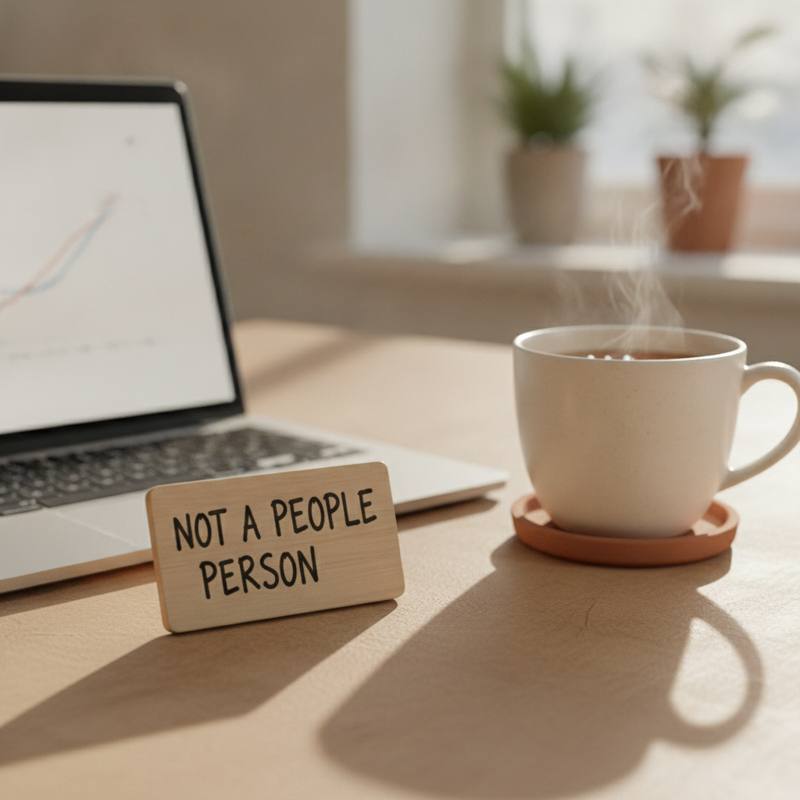
"I'm not a people person."
You've heard it in a hiring panel. You've heard it from a new manager three weeks into the job. You might have said it yourself, with a little shrug, as if you were telling someone your shoe size.
I used to believe some version of it about myself. I spent years refusing to manage people because I thought code was the better use of my brain. Code made sense. People seemed to run on rules nobody would write down for me.
Here's what I've come to believe since. "I'm not a people person" isn't a description of your personality. It's a description of your training. And training has a fix.
Zach Mercurio Counted the Skills
Debra and I had Zach Mercurio on Corey-osity Unleashed (Season 2, Episode 6). Zach researches mattering... the experience of feeling significant to the people around you.
He breaks it into three pillars. People feel they matter when others notice them, affirm them, and need them. Notice means making the time and space to see and hear someone. Affirm means showing them specific evidence of the difference they make. Need means showing them how others rely on them, and what goes missing when they're gone.
Then he said the part I keep chewing on. Across those three pillars, his team has identified 25 skills. On the show he stressed these are skills people learn.
Twenty-five. Not a temperament. Not a gift you got at birth or didn't. A list. His website now puts it at "25+ skills to ensure everyone feels seen, heard, valued, and essential," and on the podcast he said the worksheets and the full skills list are free to download from his site, with no email required.
The moment you call something a list of skills, the excuse falls apart. Nobody says "I'm not a Kubernetes person" and expects to keep the platform job. They go and learn it.
The Evidence Says Training Moves the Needle
I wanted more than one researcher's framing before I leaned on this, so I went looking for the hard question. Does training the people stuff work at all?
Victoria Mattingly and Kurt Kraiger asked it directly about emotional intelligence. Their 2019 meta-analysis in Human Resource Management Review pulled together 58 published and unpublished studies of EI training programmes. They found a moderate positive effect for training, regardless of study design. The effect held across the gender of participants and across the type of EI measure. They also note the gains sit in line with meta-analyses of other competency-based training.
There's a caution in there worth stating plainly. Published studies showed bigger effects than dissertations. Some of the headline number reflects which studies get into journals. Even so, "moderate and positive" sits a long way from "fixed at birth."
I'm not sure about this part: Mattingly and Kraiger measured emotional intelligence scores, not Zach's 25 mattering skills specifically. I haven't found a controlled study on his list itself, so I'm treating the EI evidence as a close cousin, not proof.
Engineers Know How to Learn Hard Things
On the same episode, I said something I stand by. In any highly technical job, "your whole being becomes about getting better at this." Another framework. Another language. Another certification. We assume the next technical skill makes us a better leader.
It doesn't. Leading is about connecting with your people.
And here's the irony. Engineers are some of the best learners on the planet. We take a vague, scary system and break it into parts. We practise on the parts. We read the logs. We get it wrong, look at why, and try again.
Zach makes the same point in his piece on relational versus technical skills. He argues we break technical capabilities into specific, demonstrable skills, then practise, evaluate, and require proficiency. With relational skills we send people to a workshop and stop there. His example: "active listening" is a category of skills, not a skill itself.
Read as an engineer, it's a debugging tip. You don't fix "the app is slow." You find the query. You don't fix "I'm bad with people." You find the specific skill.

What It Looked Like When I Did the Reps
I don't claim to have been naturally good at this. I claim I practised.
During lockdown I spent a lot of time on calls with my team. Debra brought this up on the show, unprompted. She said she "listened to Ken for hours on the phone when he was working from home during COVID, talking to his people." She remembered me leading about 30 people at one point, and having those conversations "week in and week out." It's a big part of why she asked an engineer to co-write our leadership book.
The conversations weren't status updates. I wanted to know where each person was aiming. Their job title says X today. Their life doesn't have to stay in pursuit of X. They might want Y next year. They might want to head into management, which is a complete left turn.
You only learn those things with regular one-to-ones. When I tried to explain this to managers who reported to me, it was a non-starter. They did not want to do it. I was mystified then. Looking at it through Zach's lens, I think I understand it better now. Many of them believed the conversation needed a talent they didn't have. So they skipped the practice, and stayed exactly as good at it as they were on day one.

Good Intentions Need Skills
Zach wrote a piece on why some leaders don't seem to care. He refuses to believe leaders wake up wanting to be uncaring. His first barrier is skill. Caring is common sense, he writes, but common sense isn't common practice. Then two lines I've written on a sticky note:
"Good intentions require great skills."
"Intuition doesn't scale. Practices and skills do."
This matters to me because of the number I keep coming back to. In my research, 99.5% of survey respondents said they've had one or more types of bad boss. Almost none of those bosses set out to be bad. Most of them, I'd bet, would describe themselves as decent people with good intentions. Good intentions weren't the missing ingredient. Skills were.
Pick One Skill This Week
You don't need all 25 by Friday. Treat it like any other skill you've learned. Start small and get reps.
Notice. In your next one-to-one, ask one question about something other than work in progress. Then stop talking. Write down what they said after the call, so you remember it next time.
Affirm. Skip "good job." Tell one person the specific thing they did and the specific difference it made. Name it so precisely they know you were paying attention.
Need. Tell someone what goes wrong when they're not there. "If it wasn't for you..." is a sentence most people never hear at work.
Do one of those three times this week. Next week, do it again. Notice what gets easier. Get Zach's free skills list and pick the next one.
Drop the Label
"I'm not a people person" sounds like honesty. It works like a permission slip. It lets you skip the practice and blame your wiring.
Your wiring isn't the problem. Your reps are.
So here's my question for you. Which of the three... notice, affirm, or need... have you been telling yourself you're "not built for"? And what would happen if you practised it for a month before deciding?