Ask someone what they're bad at and they'll hand you a list. Ask what they're good at and watch them squirm.
People know their weaknesses in high definition. Their strengths arrive blurry, hedged and apologised for.
Ian Pettigrew gave me the reason for this on our podcast, and I haven't stopped thinking about it since.
The thing you do without trying
Ian is a Gallup Certified Strengths Coach and the author of a book on hope at work. Near the end of our conversation, Debra asked him what leaders should do. Practical stuff. Monday morning stuff.
He listed a few things. Find your own hope first. Look for the glimmers. Then this:
"Celebrate people's strengths."
And he explained why. Strengths, he said, are "by definition" the things "effortless to us." And because they're effortless, "often we don't even realize them or we don't notice them."
Read the second half again. We don't notice them.
You notice the work you sweat over. The spreadsheet which took three evenings. The presentation you rehearsed in the car. Effort leaves a mark on your memory. Ease leaves nothing. So the stuff you do best, the stuff which flows out of you, never registers as a skill. It registers as "normal." As "what anyone would do."
It isn't what anyone would do. It's what you do.

We judge value by sweat
There's a piece of research which helps explain the blind spot, with a caveat I'll come to.
In 2004, Justin Kruger and colleagues described the effort heuristic in the Journal of Experimental Social Psychology. People rated a poem or a painting as better, and worth more money, when they believed it took more effort to make.
Here's the caveat. A 2023 preregistered replication in Collabra: Psychology, with 1,405 participants, got mixed results. It found support for the effect on liking and quality. It found no support for the effect on monetary value.
So the effect looks real but smaller and messier than the original paper suggested. Still, the direction matches what I see in people every day. We trust sweat. We distrust ease.
I'm not sure about this part: the effort heuristic research looks at how people judge other people's work, not their own talents. I'm applying it to self-perception because it fits what Ian describes, but I haven't found a study testing it on strengths directly.
Your brain files the good stuff under "noise"
There's a second reason your strengths stay hidden. Bad news sticks harder.
The authors of How to Play to Your Strengths in Harvard Business Review open with it. Most feedback leans negative, even when the overall review is glowing. They point to studies showing "people remember four negative memories for every positive one."
Put those two things together. Your strengths cost you no effort, so you don't notice them. And when someone does mention them, the comment fades faster than the criticism sitting next to it.
You end up with a crisp, detailed map of your flaws and a vague sketch of your gifts.
Someone else has to hold the mirror
The HBR team built an exercise around this problem. They call it the Reflected Best Self. You ask family, friends, colleagues and teachers to describe you at your best. You look for themes across their answers. Then you write a short portrait of yourself from what they told you, and use it to shape the work you take on.
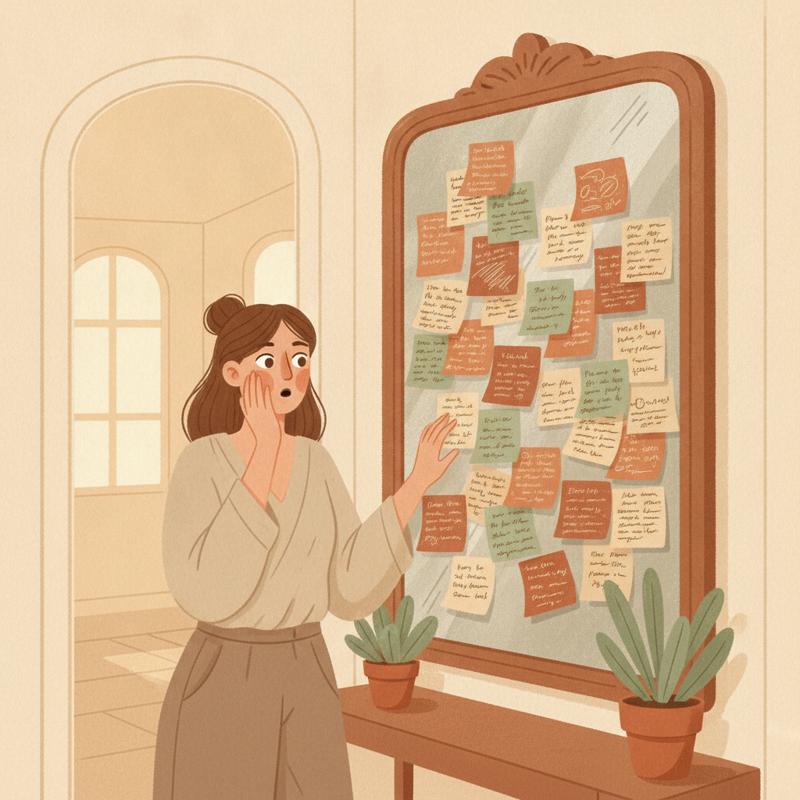
I love this because it admits something most self-help won't. You're the worst-placed person to spot your own strengths. You're standing too close.
Other people aren't. They see the thing you do without thinking and they see the effect it has. They watched you calm the room. They saw you ask the question nobody else asked. To you, it was Tuesday. To them, it stood out.
Why this is a hope problem, not a feel-good problem
Here's where Ian's point gets sharper than "be nice to people."
Hope, in the research Ian builds on, isn't a mood. It's a belief you have a goal, routes to get there and the agency to walk them. I wrote about where the science of hope started and about how I confused hope with optimism for years.
Agency needs evidence. You don't believe you'll get through something hard unless you've got proof you're capable. And your strengths are the best proof you own.
So when nobody names them, you walk into hard situations with half your kit hidden from you. You see the gaps. You don't see the tools.
Ian told us about a boss called Thomas Ernstrom. Years later, Ian still thinks about how much Thomas "encouraged" him and helped him "lean into my strengths." He's a coach and an author now. Thomas didn't hand him a strategy. Thomas handed him evidence.
The numbers on strengths at work
Gallup has pushed this for decades, so treat their figures with the care you'd give any company selling a product built on them. Gallup's chief scientist for strengths, Jim Asplund, summarised their findings like this:
- If a manager focuses mainly on an employee's strengths, the chance the employee is actively disengaged is 1%.
- If the manager focuses mainly on weaknesses, it's 22%.
- People who use their strengths every day are six times more likely to be engaged on the job.
These are correlations. A manager who talks about strengths is likely a better manager in lots of other ways too. But the gap between 1% and 22% is too wide for me to shrug off.
And it lines up with my own research. 99.5% of the people we surveyed had worked for one or more types of bad boss. I'd bet a lot of those bosses never once told someone what they were good at.
Praise isn't the same as naming
Before you rush off to tell everyone they're brilliant, stop. Vague praise does nothing here.
"Great job, team" isn't recognition, it's noise. And a careless thank you lands worse than silence when it's generic or late.
Naming a strength is specific. It points at the behaviour, the effect and the pattern:
- The behaviour: "In the client call, you summarised their complaint back to them before you answered."
- The effect: "Their whole tone changed. They stopped defending and started explaining."
- The pattern: "You do this every time. I don't think you know you do it. It's a skill, and it's rare."
The third line is the one people miss. The pattern is what turns a nice comment into evidence. It tells the person, "this isn't luck, it's you."

Do it for yourself first
Ian's first piece of advice was "find your own hope first." I'd apply the same order here.
Run a small version of the Reflected Best Self this week. Send five people one question:
"When have you seen me at my best, and what was I doing?"
Don't explain it. Don't apologise for asking. Collect the answers and look for the word or idea showing up twice.
I'll warn you now. Some answers will make you uncomfortable. You'll want to argue. "Oh, anyone does this." No. They don't. Somebody watched you do it and remembered it. Take the evidence.
Then turn it around. Pick one person on your team and name one strength this week, with the behaviour, the effect and the pattern. Not in the annual review. On an ordinary Wednesday.
Advita Patel refuses to use the word weakness, and I came round to her view. A weakness is a verdict. I think the opposite holds as well. A named strength is a plan. It tells someone what to lean on when the next hard thing arrives.
The question to carry
Your people already know their flaws. You don't need to remind them.
What they're missing is the other half of the picture. The thing they do so easily they've written it off as nothing.
So here's my question for you this week: what's the strength someone on your team uses every day without knowing it's a strength... and when are you going to tell them?