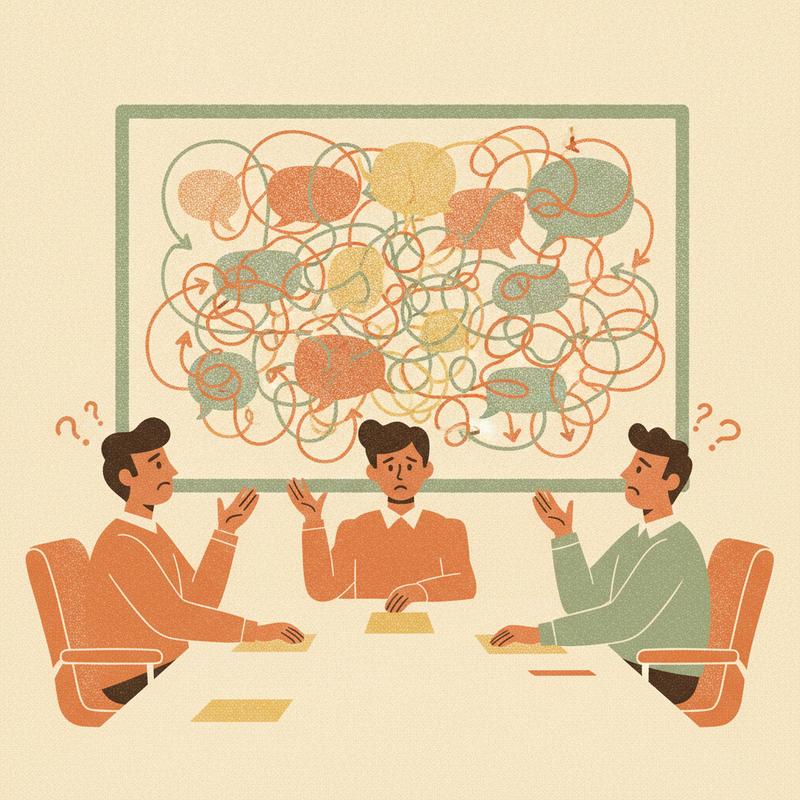
I sat through a meeting once where a director spoke for eleven minutes and said nothing.
He wanted to operationalize our synergies. He wanted to socialize the roadmap with key stakeholders before anyone double-clicked on the strategic pillars. Someone asked him what he meant. He said we needed to align on the mental model first.
I looked around the table. Eight people. Every one of them nodding. Not one of them knew what he wanted done by Friday.
I have been in leadership rooms for over thirty years, and I keep meeting the same problem wearing new clothes. The work of leading people is not complicated. The language we have built around it is.
Leadership is not a technical discipline
Think about what a good boss did for you. Someone told you the truth before it was comfortable. Someone said your name in a room you were not in. Someone gave you a job slightly too big and then stayed close enough to catch you.
None of it required a framework. None of it required a four-quadrant model with a name ending in "-ology". A twelve-year-old would understand every single one of those behaviors.
So why does the leadership industry sound like a physics department?
Because plain speech is testable. If I say "I want the pricing page live by Thursday and I will review it Wednesday afternoon", you know on Thursday whether I was any good. If I say "we are driving alignment on the customer value proposition", nobody knows anything on Thursday, including me. Fog is safer.
Big words are a status move
This is not my opinion alone. Research out of Columbia Business School by Zachariah Brown and Adam Galinsky found the pattern in the data. People with lower status use more jargon, and they use it to compensate for feeling small.
They looked at dissertations and found authors from lower-ranked schools packed in more jargon than authors from prestigious ones. In startup pitch experiments, participants made to feel low status reached for jargon. Higher-status participants went for being understood instead. You will find the write-up in Columbia's own summary of the work.
Read the finding again, because it inverts the whole thing. The person filling the air with terminology is not the smartest person in the room. Statistically, they are the one who feels least secure in it.
It gets worse. A MyPerfectResume survey cited by the NeuroLeadership Institute found 33% of employees admitted using business jargon whose meaning they did not know. A third of the room is repeating sounds. And 86% have used popular jargon at some point, so nearly everyone is in on it.
We are all standing on a stack of books pretending to be taller.

Your team pays the bill
Here is where I stop finding it funny.
LinkedIn and Duolingo ran a global study on workplace jargon in 2023. Their State of Workplace Jargon report found 40% of workers have had a misunderstanding or made a mistake at work because they did not know what a piece of jargon meant, or used it wrong.
Four in ten. Real mistakes, real rework, real evenings lost, because a leader chose the impressive phrasing over the clear one.
The same report found 61% of professionals believe people with a better grasp of workplace jargon get ahead. Sit with the finding for a second. Your people think fluency in nonsense is a promotion criterion, and they are not entirely wrong, which is the depressing part.
And it sorts people. Hybrid and remote workers reported feeling left out because of jargon at a rate of 71%, against 54% for those in the office. Jargon is a door with a password on it. Whoever is furthest from the room gets locked out first.
The generational split tells you where this ends up. 60% of Gen Z and 65% of millennials want jargon reduced or gone. Only 23% of baby boomers agree. The people arriving in your workforce have already voted, and they voted against you.
What the research on bad bosses never says
My own survey work found 99.5% of respondents said they had experienced one or more types of bad boss. Ninety-nine point five percent. It is close to a universal human experience, like sunburn.
Not one of them said their boss failed them through insufficient command of strategic vocabulary.
They said their boss took credit. Their boss went missing when it got hard. Their boss changed the target and pretended it had always been there. Their boss never once said "good work" and meant it. Their boss made them feel stupid for asking a question.
Every failure on the list is a human failure. Every fix is a human fix. No model required.
The nine-year-old test
I have a simple rule now, and I use it on myself before I use it on anyone else.
Before I say something to my team, I ask whether I would be able to say it to my grandson and have him understand it. Not the topic. The instruction.
"We need to finish the thing we promised the customer, and I told them Friday, so Friday it is." A nine-year-old gets it.
"We need to converge on a delivery posture with our external partners." A nine-year-old asks what a posture is, and he is right to.
Try it in your next one-to-one. Say the plain version out loud. It will feel exposed, and it should. Plain words carry a commitment attached to them, and everyone in the room hears the commitment land. The exposure is the entire point. Leadership without exposure is theater.

Three things to do this week
Ban one phrase. Pick the worst one in your company. "Circle back". "Leverage". "Reach out". Kill it in your own mouth first, then in your written updates. Notice how much harder your sentences have to work.
End every meeting with the plain version. Before people stand up, say who is doing what, by when, in words a stranger would follow. If you struggle to produce those words, the meeting failed and you now know it.
Invite the question. Say out loud: "if I use a phrase and you do not know what I mean, stop me". Then thank the first person brave enough to do it, in front of everyone. You have made the room 33% more honest in one move.
The uncomfortable bit
If you strip the jargon out and there is nothing underneath, you find out this week rather than in three years.
Some leaders sense this. It is why they hold on so tight to the vocabulary. The language is not a tool for them, it is a costume, and the costume is load-bearing.
Take it off anyway. The people who follow you are not impressed by it. They are exhausted by it. They want to know what you want, why it matters, and whether you will stand behind them when it goes wrong.
Rocket science is hard because rockets are hard. Leading people is hard for a completely different reason. It asks you to be honest, consistent, and present, over and over, on days when you feel like doing none of it.
No amount of terminology makes any of it easier. It only makes it easier to hide.
So here is my question for you. If you had to explain your current strategy to a nine-year-old, in words he would repeat back correctly... would you know how?