Picture a bar in Thailand. You ordered a beer twenty minutes ago. It hasn't come. You catch the waiter's eye and ask, with some heat, where the hell your beer is.
He smiles and says, "Sabai sabai."
Don't worry. The beer will come when the beer will come.
Fredrik Haren tells this story. Fredrik is the Creativity Explorer, a man who has spent 25 years interviewing creative people in more than 75 countries, and who Debra and I had on Corey-osity Unleashed. He told a longer version of it to James Taylor on the SuperCreativity podcast, and it's the best explanation of creative block I've heard. Mostly because it suggests the block isn't the problem. The worry is.

The artist who didn't understand the question
In Thailand, Fredrik interviewed an origami artist named Kai. She makes paper flowers. He asked her the question every Western creative has an answer to: what do you do when you hit a creative block?
She didn't understand the question.
He tried again. When you get stuck, what do you do?
"I go to Starbucks."
So what do you do at Starbucks? Think about the problem?
"I'm thinking of what coffee to drink."
Then what?
"Then I drink my coffee."
After thirty minutes or an hour, she goes back to the table and carries on. No drama. No crisis. No late-night spiral about whether she's lost it for good. Kai calls it an idea nap. Tired people take a power nap. Stuck people take an idea nap.
Fredrik's conclusion is the line I keep coming back to. Creative work doesn't need anxiety to happen. He says his own process has been far less anxious since he met her.
I wrote about the idea nap a few weeks ago in My Ego Has Killed More Ideas Than My Calendar Ever Did. This post is about the bit underneath it. The idea nap is a technique. Sabai sabai is the attitude which makes the technique work.
We treat a stuck moment like an emergency
Look at how most of us talk about being stuck.
Writer's block. Creative block. Hitting a wall. Drying up. Every phrase describes a disaster. Something broke, and it might not come back.
So we do the logical thing when something breaks. We push harder. We stay at the desk. We stare at the blank page, the failing test, the slide deck with no story in it, and we tell ourselves we're not leaving until it's fixed.
Kai's version has no disaster in it. The idea is late, like the beer. It will arrive. In the meantime, coffee.
Two people, same situation. One of them is having a crisis and the other is having a latte. The latte drinker gets back to work first.
The research sides with the latte
I wanted to know whether this holds up beyond one charming story. It does, with a twist I didn't expect.
Matthijs Baas, Carsten De Dreu and Bernard Nijstad pulled together 25 years of research in a 2008 meta-analysis of 102 effect sizes on mood and creativity. Negative moods which activate you and push you to avoid threat, such as fear and anxiety, went with lower creativity. The damage showed up most in cognitive flexibility, which is your ability to switch angles and see a problem a new way. In other words, the exact skill you need when you're stuck.
Here's the twist. Feeling relaxed didn't win either. The moods which produced the most creativity were positive and activating, like happiness.
Sit with what this means for sabai sabai. People translate it as "don't worry", and Fredrik translated it as "don't worry, be happy". Both halves matter. Kai doesn't go home to lie on the sofa in a fog. She goes somewhere she enjoys and picks a coffee she wants. She swaps the anxious kind of energy for the pleasant kind.
A 2023 study in Scientific Reports by Richard Daker and colleagues looked at "creativity anxiety", which is anxiety specific to creative thinking. People high in it did worse on some creative tasks. They also reported more anxiety and more effort while doing them. The authors suggest anxiety and effort make creative performance fragile under real-world pressure.
More effort. Let this land. The people most worried about creativity were trying hardest and getting the least for it.
And the coffee break itself has support. Kenneth Gilhooly's 2016 review of incubation research argues your mind keeps working on a problem below awareness when you set it aside. You step away and the work carries on without you.
I learned this face first
In October 2018 I was learning to fly a paramotor. The morning went beautifully. Clean launch, long flight, decent landing apart from falling over at the end.
The second flight did not go beautifully. First launch attempt, I tripped and face-planted. Second attempt, the wing didn't inflate properly. Third attempt, the wing came up to one side, I face-planted again and broke the tip of my prop.
I wrote about it at the time. With a ton of adrenaline in you, anger gets loud. I sat out for a while to let the emotions burn off, and went for a long walk.
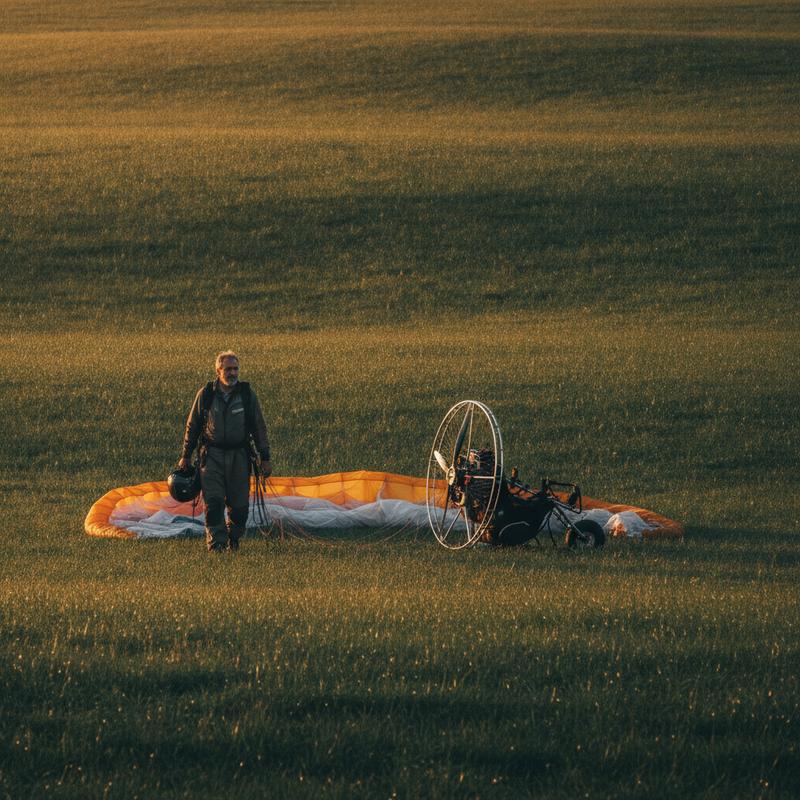
Looking back, every attempt got worse because I was angrier for each one. I was fighting the wing instead of flying it. The walk was the smartest move of the day, and I made it last.
By the time I calmed down, the wind had died. No more flying. Fine by me now. The wing would come when the wing would come.
I've seen the same pattern in 25 years of software. The bug I fixed at 11pm after three hours of glaring rarely stayed fixed. The bug I solved on the walk to the car park usually did.
How I practise sabai sabai now
I'm not Thai and I won't pretend a phrase from a culture I don't belong to turns me calm overnight. But I've borrowed some habits from Kai.
I call it late, not broken. When I'm stuck, I say it out loud: this idea is late. The word changes how my body reacts. Broken things need fixing now. Late things need patience.
I set a return time. Kai goes back after thirty minutes or an hour. A time stops the break from turning into avoidance. I'm not quitting. I'm stepping out.
I go somewhere I enjoy. Not the inbox. Not the news. Doomscrolling isn't an idea nap, it's swapping one anxiety for another. A walk, a coffee, ten minutes in the garden. The research says the good mood matters, so I go and get one.
I leave the problem on the desk. Kai thinks about which coffee to drink. Nothing else. If I take the problem with me and chew on it the whole walk, I haven't left.

If you lead people, you're the customer shouting about the beer
Here's the uncomfortable part for anyone managing a team.
When you hover over somebody stuck on a hard problem, asking for an update every hour, you're the customer banging the table. You're adding the exact emotion the research links to worse creative work. You won't get the beer faster. You'll get a stressed waiter.
Give people permission to walk away from the desk. Say it out loud, because most of them believe leaving the desk while stuck looks like slacking. Better still, let them see you do it. Take the idea nap in public. Come back with the answer.
Your team copies how you behave when you're stuck far more than anything you say about creativity in a town hall.
The beer will come
Think about the last time you were stuck on something which mattered. How much of the struggle was the problem, and how much was the panic about the problem?
Next time it happens, try Kai's answer. Pick a coffee. Drink it. Go back.
Sabai sabai.