
Everyone gives you the same advice when you're stuck in your career: find a mentor.
Get yourself a wise, experienced person who has walked the path ahead of you. Buy them coffee. Pick their brain. Let them guide you. Your career will flourish.
I believed it for years. I sought mentors. I had some decent conversations. I took notes. And then... not much changed. Not because the people were bad. They weren't. But because I was asking the wrong question.
The question I kept asking was: "What should I do?"
The question I should have been asking was: "Why do I keep making the same mistakes?"
The Mentor Myth
Here's something nobody mentions about mentoring. According to Harvard Business Review, 71% of executives who mentor tend to choose people who look like them, think like them, or share their background. The advice you receive is filtered through someone else's experience, which might have little to do with yours.
Your mentor climbed a ladder in a different decade, a different industry, a different set of circumstances. Their map is not your map.
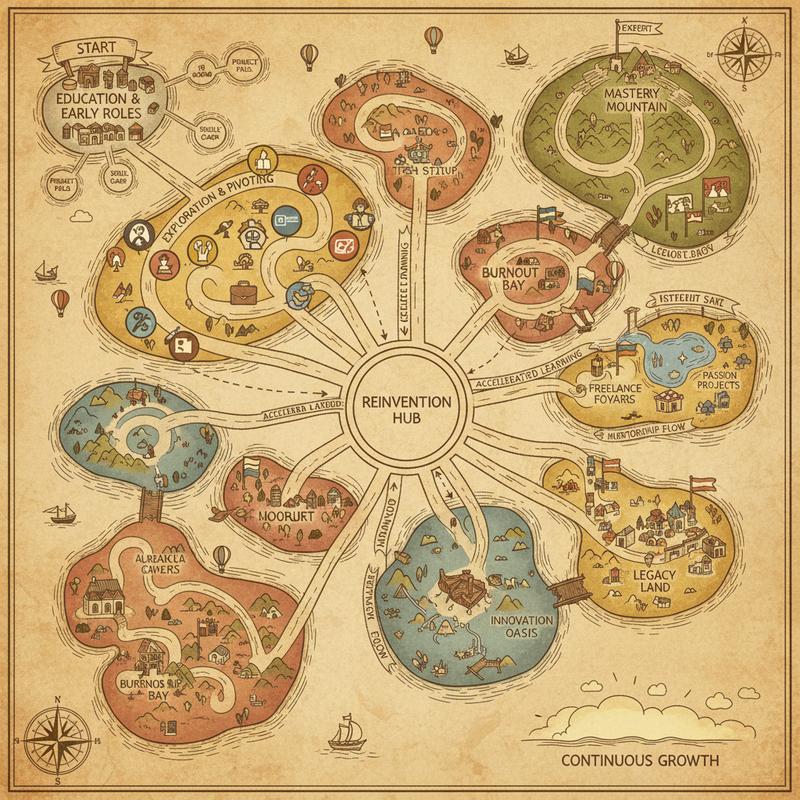
Careers aren't linear. We all know this. And yet we keep seeking advice from people who drew their route in a straight line and happened to be in the right place at the right time. When you follow their path instead of building your own, you end up confused when the terrain doesn't match the map they handed you.
I'm not dismissing mentors entirely. I'll come back to them. But first: we've turned mentorship into a substitute for something harder and more necessary, which is honest self-examination.
The Mirror Problem
Tasha Eurich is a psychologist who spent years researching self-awareness. What she found is worth sitting with. 95% of people believe they are self-aware. The real number? Between 10 and 15 percent.
Nearly everyone thinks they know themselves. Barely anyone does.
This is the real gap in your development. Not the absence of a mentor. The absence of honest reflection about who you are, what you're doing, and why you keep repeating the same patterns.
I spent the first decade of my career blaming circumstances. Bad companies. Bad bosses. Bad timing. It took sitting still long enough to look in the mirror to see the common thread in every situation where things went sideways: me.
Uncomfortable to write. More uncomfortable to admit in the moment. But it's the one thing producing lasting change.

What a Mentor Cannot Do For You
A mentor tells you what worked for them. They cannot tell you what is blocking you.
A mentor opens doors. They cannot tell you why you keep walking through the wrong ones.
A mentor shares perspective. They cannot show you the blind spots you are actively defending.
Only you are able to do this work. And it requires something foreign in a culture rewarding constant action: sitting down and asking yourself hard questions.
Here are the ones worth asking:
"What patterns keep repeating in my career?"
Not "what bad luck have I had"... patterns. If you've had three difficult managers in a row, what role did you play in choosing those roles, or in staying in them?
"What feedback do I keep dismissing?"
We all have feedback we've heard more than once and haven't acted on. The truth tends to live there.
"What am I avoiding?"
The conversation I'm not having. The skill I'm not building. The decision I keep putting off. These are often the answers to why I'm not where I want to be.
"Would the version of me from five years ago be proud of how I'm showing up?"
This one lands differently than you expect.
The Problem With Always Looking Outward

When you're always seeking someone else's perspective, you outsource your self-knowledge. You get good at absorbing other people's frameworks and terrible at building your own.
I've seen this with engineers and leaders I've worked with over the years. Smart people. No shortage of advice, books, or courses. And yet they stay stuck. Because they keep adding information without doing the harder work of examining their own assumptions and behaviors.
Self-reflection isn't navel-gazing. It's diagnostic work. You're trying to understand the system you're operating in, and you are part of the system.
Research published in PMC shows self-reflection directly improves career adaptability: your ability to respond to new challenges and changing circumstances. Not a soft outcome. The factor determining whether your career bends without breaking.
The paradox is this: the more you look inward, the better your outward decisions become. You stop reacting. You start choosing.
When a Mentor Is Worth It
I'm not throwing mentors overboard. There are situations where they're genuinely valuable.
When you need access you don't have. A mentor who knows people in a field you're trying to enter saves you years of cold outreach. Worth it.
When you're new to a context. Moving into a new industry, a new country, a new type of role... a guide who knows the terrain saves real time.
When you've done the inner work and you're ready to act. A mentor is most useful when you already know what you're building and you need tactical help executing it.
Where mentors fail is when you're using them to avoid the uncomfortable work of looking at yourself clearly. The mentor becomes a place to hide. A way to feel like you're doing something without confronting the real issue.
How to Look In the Mirror

This doesn't require anything elaborate. I do a version of this weekly, and it takes about 20 minutes.
Write down what went well. Not what you produced. What you did where things felt right, aligned, like you were showing up as your best self.
Write down what felt off. Where you avoided something. Where you reacted in a way you weren't proud of. Where you settled when you shouldn't have.
Ask: what is the pattern? Don't look at one week. Look at the month. The year. You start to see things. You start to see yourself. And there's where real change begins.
Not from a wise person across a coffee table telling you what worked for them in a different decade. From you, finally willing to be honest with yourself about what's going on.
The mirror is always available. Most people prefer not to look.
I write about leadership, career growth, and building better teams at Step It Up HR. If any of this resonated, come have a look.
What patterns have you been avoiding examining? Sit with it for a few minutes before you move on to the next thing.