For about fifteen years I answered "how are you?" with "slammed."
I meant it as a status report. It landed as a brag. Somewhere along the way I had decided a full calendar was proof of worth, and an empty hour was evidence of a man nobody needed.
Then a colleague asked me a simple question after a meeting I had run badly. "Ken, what did you move forward today?"
I had been at work for eleven hours. I had no answer.
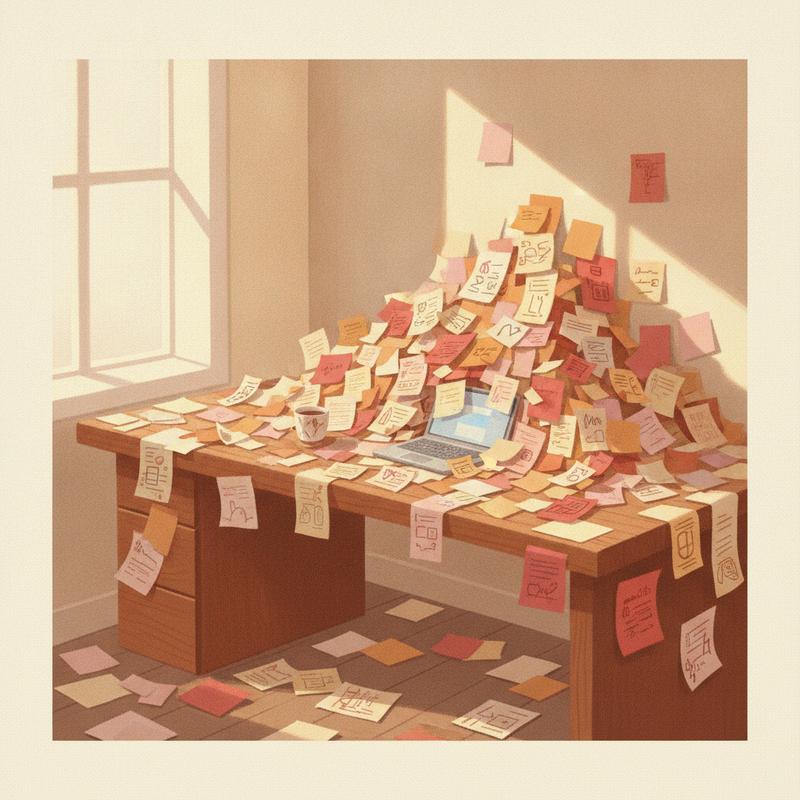
Busy is a feeling. Output is a fact.
Here is the uncomfortable part. Busy and productive feel identical from the inside. Both produce adrenaline. Both fill the day. Both leave you tired at 7pm. Only one of them leaves something behind.
Asana surveyed more than 10,000 knowledge workers for its Anatomy of Work Index and found 60% of the working day goes on "work about work" rather than skilled work. Not the job. The scaffolding around the job. The status updates, the chasing, the hunting for the version of the file with the right numbers in it.
The breakdown is brutal. 103 hours a year in unnecessary meetings. 209 hours a year on duplicated work. Two hundred and nine hours doing something a coworker had already done, because nobody told anybody.
None of those hours felt wasted while I was inside them. Every one of them felt like work.
The interruptions are not weather
The standard defense goes like this: "I'd love to focus, but the day happens to me."
Microsoft's Work Trend Index special report Breaking Down the Infinite Workday, published in June 2025, measured what "the day happens to me" looks like in numbers. 275 interruptions a day from meetings, emails and chats. For the heaviest users, an interruption every two minutes of core working hours. 117 emails. 153 Teams messages. Meetings after 8pm up 16% year on year.
And the number I keep coming back to: 57% of meetings are ad hoc, with no calendar invite at all. Over half of the meetings eating your week were never planned by anyone. They happened because somebody felt uncertain and reached for a human being to feel better.
Weather is something you endure. This is not weather. Somebody built it. Often, it was me.

The busy fool
There is an old phrase for this, and it stings: the busy fool. The person with the fullest calendar and the emptiest results. Motion mistaken for progress.
I was one. The tell was my relationship with interruption. Deep down I welcomed it, because a ping gave me something urgent to do instead of something hard. Urgent work is easy. Somebody else defined it, somebody else will thank you for it, and it finishes inside an hour. Hard work is lonely, slow, and offers no applause until it ships.
So I chose the pings. Every day, over and over, and called it being responsive.
Four things hiding behind the word "busy"
When I look honestly at my worst years, "busy" was a cover story for four separate failures. None of them were workload.
1. I had not decided what mattered
A list of twenty priorities is a list of zero priorities. I kept everything alive because killing a project meant telling somebody no, and telling somebody no meant a hard conversation. Cheaper, in the short run, to stay slammed.
2. I over-collaborated
In Collaborative Overload, Cross, Rebele and Grant reported for Harvard Business Review back in 2016 on collaborative time growing by 50% or more. Ten years ago, before the chat tools got good at pestering us. I copied people in to spread responsibility. It spread confusion instead.
3. Nobody knew who decided
Half my meetings existed because two teams each believed the other owned a call. An unclear decision right generates meetings the way a leak generates buckets. You mop forever and never fix the pipe.
4. I would not say no
This one is the root of the other three. I said yes to protect a relationship, then resented the work, then did it late, then apologized, then said yes again. Saying yes felt generous. It was cowardice wearing a nice coat.
What changed it for me
No app fixed this. Three habits did.
I wrote down the three things. Every Monday morning, three outcomes for the week. Not tasks. Outcomes. If a request arrived and served none of the three, it went to a list I reviewed on Friday. Most of the list died of natural causes, unmourned.
I made saying no specific. "No" on its own sounds like rejection. "No, because I'm shipping X by Thursday, and I'd rather do one thing properly" sounds like a plan. People rarely argue with a plan. They argue with a shrug.
I killed my own meetings first. I cancelled the recurring ones I owned before I complained about anybody else's. Two of them nobody missed. One of them somebody thanked me for. The team noticed the direction of travel, and within a month they started killing theirs.

Your calendar is a memo to your team
This is where busyness stops being a personal quirk and becomes a leadership problem.
My research turned up a number I have never shaken. 99.5% of survey respondents said they have had one or more types of bad boss. Almost everyone. Not a rare pathology. The default experience of work.
Most of those bosses were not cruel. They were overloaded. An overloaded leader has no attention left, and attention is most of the job. You skip the one-on-one. You give feedback late, and by then it has gone sour. You approve things you have not read. You reply at 11pm and teach your team the hours are unlimited.
Your team reads your calendar as a values statement, because it is one. If your week says "I take every meeting and protect nothing," they learn to do the same. Busyness is contagious, and you are patient zero.
Overload deforming how people lead is the territory I work in over at Step It Up HR.
The test
Here is the one I use on myself, still, on a bad week.
At 6pm, name the thing you moved forward today. One thing. A decision made, a person unblocked, a piece of work finished and out the door.
If the honest answer is "I responded to a lot of stuff," you did not have a busy day. You had a disorganized one. The volume was real. The direction was missing.
The fix is not more hours. You have no more hours. The fix is deciding, out loud, what you are willing to be bad at.

So, what did you move forward today? And if you struggle to name it, which of those four failures was it... no priorities, too many people, no clear owner, or no spine to say no?
Pick the one. Fix the one. Your team is watching your calendar, whether or not you want them to.