Somebody in your company will cry this month. Odds are it happens in a stairwell, a parked car, or a bathroom with the tap running so nobody hears.
You will never hear about it either. And what you do in the ten minutes after you find out says more about your culture than every value painted on the wall in the lobby.
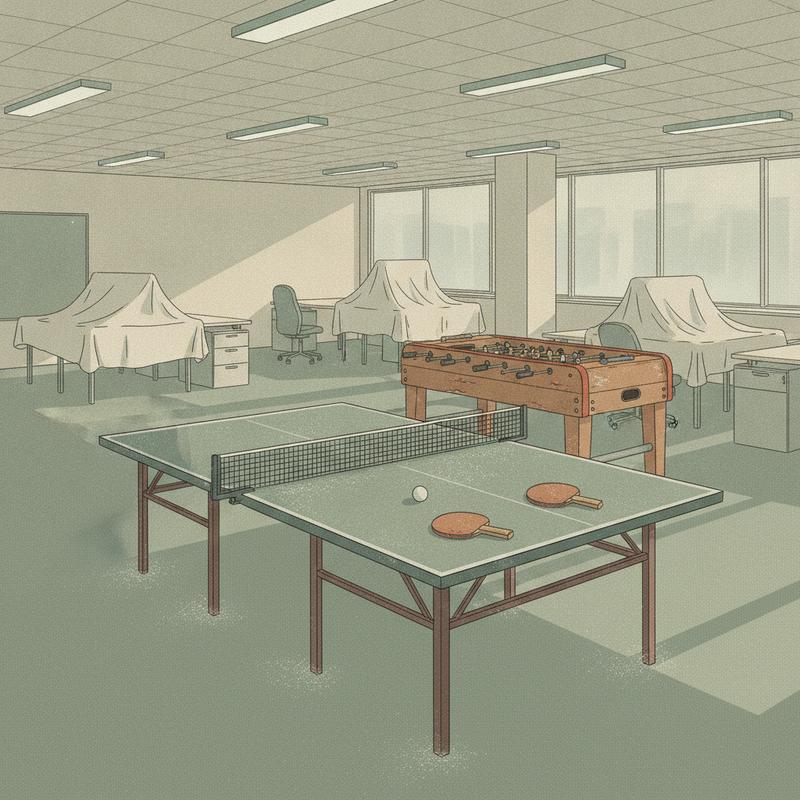
A line from Ruth Wooderson has been rattling around my head for weeks: culture isn't the ping-pong table, it's how you act when someone cries at work. She's right. And most companies fail the test without ever knowing they took it.

Perks are the easy part
Buying a ping-pong table takes one purchase order. Free fruit takes a standing order with a supplier. A wellbeing app takes a per-seat licence and a launch email with a smiling stock photo.
None of it requires a single leader to sit still while another human being falls apart in front of them.
I've walked through offices where the table tennis paddles had a layer of dust on them thick enough to write your name in. Nobody plays. Nobody has time to play. The table sits there as proof of something, a receipt for caring, filed and forgotten.
Perks are what you buy. Culture is what you do when the buying stops working.
The numbers nobody puts on the careers page
This isn't a rare event you'll face once in a career. It's routine, and the research says so.
Resume Now surveyed 1,018 US adults in December 2025. Thirty-nine percent said they had cried at work. Another 21% said they came close without tipping over. Add those together and you get six in ten people who have sat at a desk fighting their own face.
The top driver wasn't workload. It was uncertainty. Fifty-two percent said they worry about losing their job with no clear reason given. People aren't crying because the sprint is hard. They're crying because nobody will tell them where they stand.
Then there's the part I find harder to sit with. A study of 600 US professionals by resume.io found 87% of the people who cried at work hid it. Over half hid it completely from every colleague. Researchers have a name for it now: cry masking. Performing composure while the wheels come off.
Gen Z reported the highest rate, close to 39% in six months, against 17% of Gen X. Read it as young people being fragile if you like. I read it as young people being slightly more honest on a survey form.
The eleven minutes after
Here's the thing about the moment itself. It arrives with no warning, in a one-to-one about a delivery date, and you have about a second to decide who you are.
What I do, and what I've watched good leaders do:
Stop talking. Whatever point you were making has stopped mattering. The agenda is dead. Let it be dead.
Don't hand over tissues as a hint. Tissues on the table, fine. Tissues pushed across the desk with a look means "wrap this up." People read it instantly.
Don't fix it. Your instinct will be to solve, reassure, or explain why it isn't as bad as it feels. All three land as "please stop." Sit with it. Silence is doing work even when it feels like doing nothing.
Don't outsource them. "Have you thought about the Employee Assistance Programme?" in the first thirty seconds is a door being closed politely. Signposting help is fine, later, once they know you heard them first.
Give back control. One question does most of the heavy lifting: "Do you want to keep going, or pick this up tomorrow?" They choose. Not you.
Then let it go, forever. Never bring it up in a performance conversation. Never mention it to their next manager. Never use it as evidence of anything, ever. The moment you trade on someone's worst ten minutes, you've told every person they talk to what you are.

The hiding is the real diagnosis
Look again at the 87%.
The crying isn't the culture problem. People cry at work for reasons with nothing to do with work. Sick parents. Divorce. Two hours of sleep. A dog put down last Tuesday. Grief has no respect for your calendar.
The culture problem is the hiding. Nine in ten people going to the trouble of concealing an ordinary human response, from people they see forty hours a week, because being seen as it happens costs more than the pain of holding it in.
Ask what those people believe. They believe tears will be recorded. Filed under "not ready for the next level." Repeated at a calibration meeting where they aren't in the room. And they believe it because for a lot of them it happened, or they watched it happen to somebody else.
Amy Edmondson has spent decades on this. Her research on psychological safety, laid out in The Fearless Organization, comes down to whether people believe they will be punished or humiliated for speaking up. Tears are speech. Involuntary speech, at maximum volume, with no way to walk it back. If your people won't risk it in front of you, sit with what else they've decided against telling you.
Nobody hides their tears from someone who has earned trust. So the hiding rate in your building is a scoreboard, and you don't get to see it.

Culture lives in small rooms
Big culture gestures are performed for an audience: the all-hands, the offsite, the values workshop with the sticky notes. They're all rehearsed, and everybody knows it.
Real culture gets set in rooms with two people in them and no witnesses. A redundancy delivered by someone who stays in the chair afterward instead of handing over to HR and leaving. A manager saying "I got this wrong" out loud to a junior engineer. Someone crying, and nobody in the room treating it as an incident.
Those moments cost nothing and they're worth more than the entire perks budget. They're also the ones leaders dodge hardest, because they're uncomfortable, unscripted, and there's no slide deck to hide behind.
The uncomfortable part is where the whole thing gets decided. If you want to know what I mean by leaders getting the human moments right, most of my work with Step It Up HR starts exactly there.
The test you're already taking
You don't get to opt in. Someone on your team is running the experiment on you right now, watching how you handle the small stuff, deciding in advance whether they'd let you see them at their worst.
So ask yourself an honest question. Not "do we have a good culture," which every leader answers yes to. Ask this instead:
If somebody on my team broke down in front of me tomorrow, would they feel safer afterwards or more exposed?
You already know the answer. And so do they.