On 7 October, Anthropic released Claude Haiku 5.5, its smallest and cheapest model. The model overview lists a 1M token context window. The pricing is ten cents per million input tokens for prompts under 100,000 tokens, and fifty cents per million above it.
My first thought was the obvious one. What would I feed it?
So I went and counted. I didn't expect the answer to bother me as much as it did.
Everything I've Published Fits in One Prompt
I started with this website. The API returns every post. I added up the text.
527 posts. About 603,000 words. Roughly 3.9 million characters, going back to 2013.
The usual rule of thumb says one token is about four characters of English. By my rough count, everything I've ever published here comes in a little under a million tokens.
I'm not sure about this part: the four-characters-per-token rule is an estimate, and markdown, links and image tags will push the real figure around. I didn't run the text through a tokeniser.
Close enough. Every post I've written about bad bosses, paramotors, holidays and software architecture would sit inside one request. At the over-100k price, reading the lot once costs around fifty cents.
Half a dollar to read my whole public body of work. I sat with the number for a minute.

Then I Counted My Notes
Next I pointed the same count at my Obsidian vault. This is where I keep everything. Or where I thought I kept everything.
The vault holds 15,119 markdown files. Here's where the words live:
- Email archive: 11,919 files, about 5.9 million words
- Clippings: 891 files, about 4.1 million words
- My assistant's working notes: 1,209 files, about 300,000 words
- Old Notion export: 771 files, about 150,000 words
- Daily notes: 3 files, 404 words
- Family: 1 file, 126 words
- Career: 1 file, 557 words
Read the bottom of the list again. I've got four million words of other people's articles saved. I've got six million words of email. My daily notes come to 404 words across three days in 2026.
My family folder holds 126 words. They're ID numbers and helpline phone numbers.
I Built a Library of Everyone Else
Clippings feel productive. You read something good, you hit save, and it feels like learning. I've done it 891 times.
But a clipping is someone else's thinking. It sits in my vault the way a book sits on a shelf. Owning it isn't the same as having read it, and reading it isn't the same as knowing what I think about it.
Email is worse. Most of those 11,919 files are logistics. Invoices. Calendar invites. Newsletters I never opened. Insurance renewals. Some of it matters. Most of it is noise I never threw away.
A model with a million-token window will read all of it without complaint. It'll summarise my inbox. It'll find patterns across four million words of clippings. It'll tell me what Fortune said in 2025 and what some Substack writer argued last spring.
It won't find out what I thought on a Tuesday in March, because I never wrote it down.
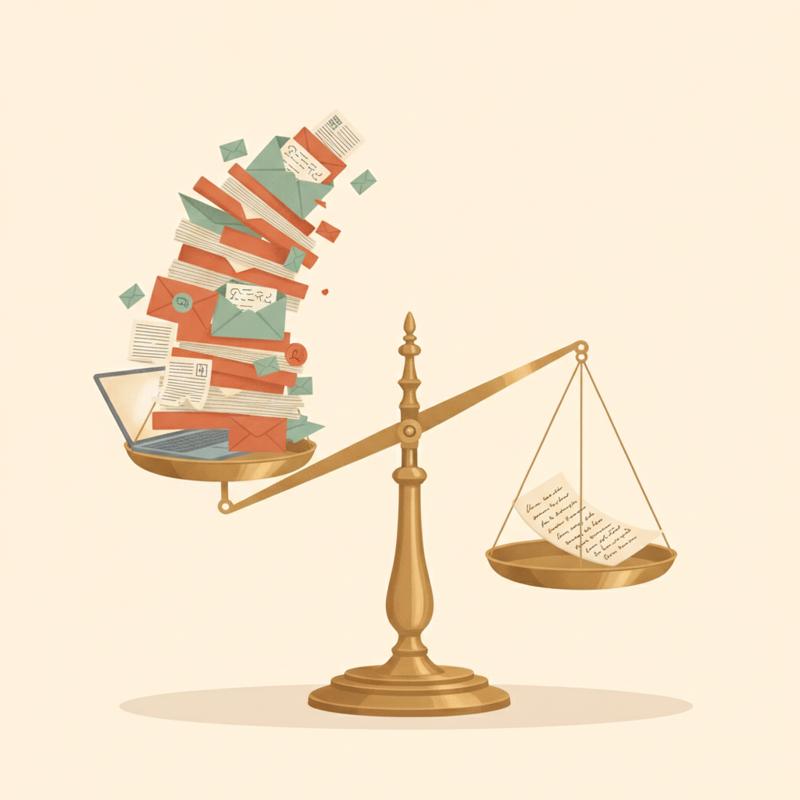
The Window Got Bigger. The Gap Got Easier to See.
For two years the excuse was size. Models forgot things. You had to chop your notes into pieces and hope the right piece came back. I wrote about this in Stateless AI Is Like Hiring Someone Who Forgets You Every Morning.
The window problem is mostly gone for a person like me. My whole public writing fits. My notes, minus the email and clippings, fit with room to spare.
Which leaves the real problem sitting in plain view. The bottleneck isn't the machine's memory any more. It's mine. Or, to be honest, my habit of not keeping one.
Anthropic's own announcement says prompts up to 100,000 tokens make up around 90% of requests to its previous Haiku model. Most people send small, focused prompts. They pick what matters. The pricing rewards you for doing the same. Stay under 100k and the price drops by a factor of five.
I like the idea as a personal rule too. If I had to choose 100,000 tokens of my own life to hand to someone, what would I pick? Not the insurance PDFs. Not the clippings.
I'd want the stuff I never wrote.
The Same Gap Shows Up at Work
I've spent a lot of my career managing engineers. I've watched this pattern play out on teams too.
A manager reads every leadership book going. They save the frameworks, the templates, the podcast notes. Then you ask them what they learned from the last reorg, or why their best developer left in the spring, and there's nothing written down. The lesson lived in their head for a week and then it was gone.
Teams do it with tooling. They keep every Slack message, every ticket and every log line forever. Ask why a big decision got made eighteen months ago and nobody finds it. The record holds everything except the reasoning.
Bigger AI context windows will make this worse before it gets better. It's tempting to think the machine will dig the meaning out of the pile for you. It won't. It'll summarise what's there. If the thinking never got written, no model will find it.
The fix is boring. Write down what you decided and why, in your own words, close to when it happened. A few sentences beats a perfect template nobody fills in.
What I'm Changing
I'm not deleting the clippings. Some of them earn their place. But I'm changing what I put in.
One paragraph a day, in my own words. Not a journal with a template. Only what happened, what I thought, and what bugged me. Three daily notes in a year is pathetic for a man who publishes a blog.
One sentence with every clipping. If I save an article, I write one line about why. If no line comes, I don't save it.
A family folder worth the name. 126 words of reference numbers. I've got a grandson. I've got my wife Debra, our kids, and stories from my Army years nobody has heard. None of it lives in the place I call my second brain.
The 100k test, once a quarter. I'll ask myself what I'd hand over if I only had 100,000 tokens. Whatever I pick, I'll check it exists in writing.

The Audit Is the Point
I've done a few of these machine audits lately. I checked my laptop for leaked secrets. I found my server hadn't booted six kernel fixes. Each time, the news story was the prompt. The useful part was what I found when I looked at my own stuff.
This one stung more than the others. Leaked keys and unbooted kernels are technical debt. Four hundred words of daily notes is something else. It says I've been collecting and not reflecting.
A cheap model with a huge window doesn't fix this. It makes the gap obvious. Everything I saved is ready to be read. The things I meant to think about are missing.
So here's my question for you. Open your notes app tonight. Count the words you wrote yourself, about your own life, this year. Then count what you saved from everyone else.
Which pile would you want a machine, or your grandkids, to read?